הגעת למגבלת הצפייה למשתמשים שאינם רשומים באתר
  • נשמח אם תצטרפו לקהילה שלנו. הרשמה לאתר תקנה לכם את האפשרות לשאול שאלות ולהגיב לשרשורים באתר ללא כל עלות
  • טופס ההרשמה לאתר נמצא כאן למטה ולוקח פחות מ-30 שניות למלא אותו (כן, בדקנו עם סטופר 🤓)

דגים גדולים כמו טונה יכולים להזיק לבריאות הנפש (הרעלת כספית)

עוד פעם להביא לך ציטוט?

תגובה 1
"אתה פשוט הבדיחה שכולם צוחקים עליה שחושבים שכל הGMOs הם רעל וחיסונים גורמים לאוטיזם.
בחיי, תפסיק. אתה רק מבייש את עצמך."

מדבר פה על רוב האתר של LBS "כולם צוחקים עליך שחושבים שכל ה GMOS הם רעל וחיסונים גורמים לאוטיזם"

ואז מגיב:
armyswat: רוב האנשים הם לא טיפשים, ורוב האנשים הם נגד FDA, נגד מונסנטו, נגד האישורים החומרים ש ה FDA אישרו.

תגובה 2
Matty: "אד פופולום (לטינית: ad populum, מילולית: בשם הרוב) - ביסוס הטיעון על העובדה שרוב או כל האנשים תומכים בו. הטיעון מוכר גם בשמות נוספים כמו "אד נומרום" (לטינית, ad numerum, לפי המספרים), "הצטרפות לעגלת המנצח", "טיעון לפי הקונצנזוס""

תגובה 3
"זה לא מצדיק את זה.
אתה אומר שעריצות הרוב הוא הדבר הנכון תמיד? והוא תמיד צודק כי הוא הרוב?"

"לא זכור לי שאלו המקומות למצוא מידע מחקרי ומדעי מוכח. "
ועוד פעם אני אומר לך, אני לא אמרתי שאני מתבסס על הרוב אוטומטית אלא על ראיות מוצקות ואני לא אוטומטית אומר שהם צודקים, אבל הרוב
כן מצדיק את המילים שלי לא משנה לאיפה שאלך. גם בסרטון של GMO ביוטוב שפרסמתה של DNEWS, בתגובות אפשר לראות, אולי חלק
חושבים ש GMO שזה סתם שטויות אבל תשים לב מה הם אומרים על Aspartame, MSG, high Fructose corn syrup, יצא לי לדבר עם אחד שם
והוא אמר שהוא מסכים איתי וגם חלק מהשאר הכסיכמו איתי. הנה ציטוט מהשיחה:

אני (מקבל דירוג של אנשים אחרים)
"u forgot the fact why 70% of u.s are overweight and forgot all of the insane mad mental illnesses and physical in the u.s"

אני
"i think u should care here and ask why is it even happening, why? coz the FDA protects u so well, approves every dangerous drug, SSRI drugs, aspartame, MSG, GMO, arsenic, mercury in fish and etc. which many are banned in EU."

מגיב ראשון
Such science, WOW.

מגיב שני
"lifestyle is the main factor in those and gmo can't be blamed for any of those issues"

אני למגיב ראשון
what do u mean? and where did u take that GMO is safe? they made multiple studies on rats and it gave them tumors.. i don't trust FDA because they approved many many dangerous stuff, aspartame, gmo stuff, msg, fructose corn syrup and they're to be blamed for the epidemic disease in u.s. FDA is trying to kill you, all they care is money and killing people

אני למגיב שני
The citizens can't be blamed here, do you see such thing happening in europe? nope it doesn't, in europe they ban 1,000 things which are approved by the FDA. look here The EU Has Banned Over 1000 Chemicals; The FDA Has Only Banned 9

First they put mcdonalds in every corner in U.S, government approves all the dangerous stuff. the food industry, believe it or not they hire crave expert just so people will be hooked on food. they make their food addictive so you'll get that dopamine burst in your brain when you touch that stuff and you'll want more and more of it. and make so many tv ads on food, which can be dangerous for kids, when they'll enter the store they'll want to buy that stuff. and promoting all of the junk stuff.

Sport won't do anything with weight, it's a myth that it will, if you'll eat chocolates, junk stuff and exercise, you'll never lose weight. but if you just cut down the bad stuff you'll lose weight without exercise, check this viral video


מגיב שני כותב ומסכים איתי אבל לדעתו חושב שרק fructose corn syrup הוא בסדר
"i strongly doubt those studies passed per-review.

while agree with aspartame,msg is a salt no more dangerous any other.fructose corn syrup is sugar nothing wrong with it in moderation. also im thinking getting food regulators mixed up with tabacco companies."


אני מגיב (מקבל דירוג)
"dude high fructose corn syrup is the worst.. look up in google.. Diabetes, weight gain, decays tooth, hair loss, high cholesterol, increases blood presure, linked to cancer, speeds up aging"

נגמרת השיחה.

ולאן שלא תלך תראה אנשים (הרוב) שמחזקים את מה שאני אומר. עוד פעם אגיד לך אם לא קלטתה, אני לא הולך עם הרוב אוטומטית אלא על ראיות מוצקות קודם כל, אני לא מסתמך על הרוב,
אבל מה שאני חושב, הרוב חושב אותו דבר באינטרנט.

והפרס על ההודעה הארוכה ביותר וחסרת תוכן אי פעם בתולדות LBS הולך אל...... *תופים*

🥰🙃

👏👏👏👏


את כל זה העבור,
כשאתה מנסח את זה ככה קשה לי לדמיין 740 בפסיכומטרי.

בקצרה, סיים לימודי רפואה. תתמחה בתזונה או שלחילופין תעצור את סדר היום המטורף שלך בתור home school ותקרא מחקר מתחילתו ועד סופו.

טיפ לחיים: תואר לא עושים ביאהו, זה לא מאושר על ידי המל"ג
 
  • פותח/ת השרשור
  • #82
והפרס על ההודעה הארוכה ביותר וחסרת תוכן אי פעם בתולדות LBS הולך אל...... *תופים*

🥰🙃

👏👏👏👏


כשאתה מנסח את זה ככה קשה לי לדמיין 740 בפסיכומטרי.

בקצרה, סיים לימודי רפואה. תתמחה בתזונה או שלחילופין תעצור את סדר היום המטורף שלך בתור home school ותקרא מחקר מתחילתו ועד סופו.

טיפ לחיים: תואר לא עושים ביאהו, זה לא מאושר על ידי המל"ג
אהא, אוקיי, מה שתגיד אלוהים.

ומי אומר שאני עושה תואר ביהו? מה הבעיה עם ללמוד לבד מהבית לפני תחלית הלימודים אוטוטו דרך ספרים של רופאים אחרים ועוד בנתיים שאני מחכה עד שאתחיל את הלימודים?

מחקרים אני קורא וקראתי מההתחלה עד הסוף אבל זה לא כעדיפות ראשונה כרגע לקרוא מחקרי ANTI
לגביי מה שאני אומר וגם מחקריי בעד מה שאני אומר בשביל להשוות בין השתיים ולהסיק מסקנות מפה.
 
מדבר פה על רוב האתר של LBS
לא..
ולאן שלא תלך תראה אנשים (הרוב) שמחזקים את מה שאני אומר
למי אכפת? אז אם אני אגיד שצריך לשרוף את כל היהודים ואני אקבל תמיכה מהנאו-נאצים אני צודק?
ההתבססות שלך על תגובות ביוטיוב פשוט מגוחכת.
 
  • פותח/ת השרשור
  • #84
לא..

למי אכפת? אז אם אני אגיד שצריך לשרוף את כל היהודים ואני אקבל תמיכה מהנאו-נאצים אני צודק?
ההתבססות שלך על תגובות ביוטיוב פשוט מגוחכת.
wow, אני לא יודע עם מי אני מדבר אפילו, יש לך בעיות קליטה, כי בבירור לא הבנתה את מה שכתבתי.
תשחק כדורגל בנתיים.
 
אהא, אוקיי, מה שתגיד אלוהים.
לא הבנת מה הבעיה במה שרשמת נכון?


ומי אומר שאני עושה תואר ביהו?

מה נראה לך שיש לי את כל הזמן בעולם?
יש לימודים, רפואה
כבר בלימודים חצי שנה על ידיי עצמי,
 
  • פותח/ת השרשור
  • #87
לא הבנת מה הבעיה במה שרשמת נכון?
"כשאתה מנסח את זה ככה קשה לי לדמיין 740 בפסיכומטרי. "
Lol, אתה מראה ספק שאני יעבור את מבחניי הפסיכומטרי. אז אמרתי לך "טוב אלוהים" אתה יודע הכל בהנהון כן, ומה שתגיד.
לי פשוט אין ספק ולא רואה שום דרך שלא העבור את המבחנים, כשאני נעול על מטרה להשיג, אצלי אין דבר כזה אי אפשר.
 
"ואם רפואה קונבנציונלית עובדת והמשרד הבריאות הם כאלו מלאכים, למה כל כך הרבה אמריקאים כל כך לא בריאים?
חשבתה פעם למה אחוז כל כך גבוהה של אמריקאים עם סכרת, בדכאון, סובלים מסרטן, מחלות לב, מחלות כליה ובעיות בעור?
And consider the fact that americans pay more per capita for health care than any other nation in the world."

יש משהו מעניין שקורה כשאתה נותן לבעלי חיים לאכול כמה שהם רוצים. הם משמינים ומתחילים לחלות במחלות מטבוליות והחיים שלהם מתקצרים. תגביל להם קלוריות ותראה איך הם חיים יותר ובריאים יותר ווזה משהו שנחקר אצל כמעט כל עולם החי.

בני אדם לא באמת שונים מבע"ח מהבחינה הזאת כשיש להם שפע הם אוכלים בכמויות ומשמינים. אם הם מקפידים על כמות הקלוריות שהם אוכלים ועל תפריט מאוזן הם נשארים רזים ובריאים...

זו הסיבה היחידה שהאמריקאים שמנים כי יש להם שפע ולמרות כל המחלות הללו בגלל הרפואה המודרנית תוחלת החיים עלתה בהרבה במאה האחרונה:
Life Expectancy at Birth by Race and Sex, 1930–2010
גם זו שלא מתחשבת בתמותת תינוקות:
http://www.infoplease.com/ipa/A0005140.html

סרטן, מחלות לב וסכרת אלו מחלות של גילאים מבוגרים שלא היו נפוצות כשאנשים מתו מזיהום בגיל 40-50 .

והאמריקאים מוציאים הכי הרבה בעולם כי מערכת הבריאות שלהם והתרופות גם עם האובמה-קר פשוט יקרים יותר.

ולפי מה שאתה כותב אתה לא יודע דבר. מה אני יכול להגיד, תמשיך לאכול MSG בשפע? בתוספת אספרטיים ופרוקטוז תירס?
רק אל תתלונן למה קיבלתה סרטן או השמתנת 50 קילו
בעוף למשל יש יותר MSG מבכל התבלינים פשוט בגלל שבעוף יש במקרה חלבון עם הרבה חומצה גלוטמית ויש אגב גם הרבה ירקות שיש בהם הרבה ממנה.

זו בסך הכל חומצה אמינית שמשמשת גם כניורוטרנסמיטר במוח. יש טענות שכשאתה אוכל כמויות אדירות ולא טבעיות שלה היא יכולה לזלוג למוח ולעשות כאבי ראש אבל הם לא הוכחו אף פעם. בכל מקרה יש לי חבר טוב שבמקרה אוכל הרבה מכל הדברים הללו ויש לי ריבועים בבטן כי הוא סופר קלוריות.

יש כרגע רק מחקר אחד אמין, במקרה ממכון ויצמן, שמראה שאספרטיים מזיק ופרוקטוז יש רק אחד והוא נמצא גם בפירות. לא הייתי ממליץ לאכול ממנו יותר מידי כי פירות באמת יכולים להעלות LDL כשמגזימים איתם אבל הוא לא מזיק ברמה שעשית ממנו. אם אתה עושה פעילות גופנית ואוכל הרבה סיבים אתה תיהיה בסדר...

כשאתה בולע אנטיביוטיקה זה הורג גם את החיידקים הטובים וגם את הרעים, זה רק בגדול נותן יותר מקום לחיידקים המזיקים להתרבות.
לא נכון, הגוף עושה ברירה טבעית לחיידקים מהאוכל ומטפח את המינים העיקריים שהוא צריך מהמזון ע"י שליטה בתנאי המחייה שלהם במעי. ככה ברוב המקרים מצליחים לשחזר את המינים העיקריים שצריך במעי.
 
  • פותח/ת השרשור
  • #90
יש משהו מעניין שקורה כשאתה נותן לבעלי חיים לאכול כמה שהם רוצים. הם משמינים ומתחילים לחלות במחלות מטבוליות והחיים שלהם מתקצרים. תגביל להם קלוריות ותראה איך הם חיים יותר ובריאים יותר ווזה משהו שנחקר אצל כמעט כל עולם החי.

בני אדם לא באמת שונים מבע"ח מהבחינה הזאת כשיש להם שפע הם אוכלים בכמויות ומשמינים. אם הם מקפידים על כמות הקלוריות שהם אוכלים ועל תפריט מאוזן הם נשארים רזים ובריאים...

זו הסיבה היחידה שהאמריקאים שמנים כי יש להם שפע ולמרות כל המחלות הללו בגלל הרפואה המודרנית תוחלת החיים עלתה בהרבה במאה האחרונה:
Life Expectancy at Birth by Race and Sex, 1930–2010
גם זו שלא מתחשבת בתמותת תינוקות:
http://www.infoplease.com/ipa/A0005140.html

סרטן, מחלות לב וסכרת אלו מחלות של גילאים מבוגרים שלא היו נפוצות כשאנשים מתו מזיהום בגיל 40-50 .

והאמריקאים מוציאים הכי הרבה בעולם כי מערכת הבריאות שלהם והתרופות גם עם האובמה-קר פשוט יקרים יותר.


בעוף למשל יש יותר MSG מבכל התבלינים פשוט בגלל שבעוף יש במקרה חלבון עם הרבה חומצה גלוטמית ויש אגב גם הרבה ירקות שיש בהם הרבה ממנה.

זו בסך הכל חומצה אמינית שמשמשת גם כניורוטרנסמיטר במוח. יש טענות שכשאתה אוכל כמויות אדירות ולא טבעיות שלה היא יכולה לזלוג למוח ולעשות כאבי ראש אבל הם לא הוכחו אף פעם. בכל מקרה יש לי חבר טוב שבמקרה אוכל הרבה מכל הדברים הללו ויש לי ריבועים בבטן כי הוא סופר קלוריות.

יש כרגע רק מחקר אחד אמין, במקרה ממכון ויצמן, שמראה שאספרטיים מזיק ופרוקטוז יש רק אחד והוא נמצא גם בפירות. לא הייתי ממליץ לאכול ממנו יותר מידי כי פירות באמת יכולים להעלות LDL כשמגזימים איתם אבל הוא לא מזיק ברמה שעשית ממנו. אם אתה עושה פעילות גופנית ואוכל הרבה סיבים אתה תיהיה בסדר...


לא נכון, הגוף עושה ברירה טבעית לחיידקים מהאוכל ומטפח את המינים העיקריים שהוא צריך מהמזון ע"י שליטה בתנאי המחייה שלהם במעי. ככה ברוב המקרים מצליחים לשחזר את המינים העיקריים שצריך במעי.
אתה טועה לגביי השמנת יתר בארצות הברית, אתה בעצם מאשים את האנשים פה ולא את הממשלה כשהם מאשרים
כל דבר מסוכן לבריאות ומשמין, The EU Has Banned Over 1000 Chemicals; The FDA Has Only Banned 9
שמים מקדונלדס בכל פינה, מפרסמים ושמים המון כסף על פרסומות JUNK בטלויזיה, שיכול להיות מסוכן לילדים קטנים, כשהם נכנסים לחנות הם בוחרים דברים שהם ראו בפרסומת. תאמין או לא תעשיית המזון, שוכרת מומחים לתשוקת אוכל בשביל שהואכל יהיה ממכר, כשתגע בזה, זה ישחרר
רמות גבוהות של דופמין (נאורוטרנסמיטר האחראי על מוטיבציה, רצון לעסוק בחיים, תגמול ועוד), שתאכל עוד ועוד.

תקרא את הספר The blood sugar solution 10-day detox diet על ידיי רופא גדול באמריקה מספר למה אנשים שמנים ולמה יש המון מחלות בארצות הברית בצורה מפחידה.

ותחולת החיים יותר גדולה עכשיו? אולי, אבל יותר מתים? לפני 100 שנה היה יותר קל למות מכדור מאשר למות מסרטן כי כמעט זה לא היה.
וגם אוטיזם זה היה נדיר ולמה שהו אחרי מלחמת העולם השנייה זה התחיל לגדול בצרות מטורפות אחרי שפיתחו את האנטיביוטיקה והתחילו לתת חיסונים לילדים קטנים (שמכילים כספית). וגם לא היו כמעט שמנים בארצות הברית לפני 50 או 100 שנה בערך, זה הולך וגדל. תודות לממשלה, ל FDA, מונסטו ועוד.

והתכוונתי ל High fructose corn syrup לא סוכר של פירות. שזה בהרבה יותר גרוע מסכור רגיל. ואתה טועה לגביי שסוכר של פירות מעלה את רמות הכולסטרול הרע LDL, אמא שלי אוכלת המון פירות כל יום, לפחות 15+ או 10. ב 30.11.2015 אני והיא עשינו בדיקת דם לא בגלל כולסטרול LDL, אבל אחרי 5 שנה עם אכילת פירות בצורה גבוהה ה LDL שלה הוא מאוד נמוך 85.30 מ"ג לכל דציליטר
DSSS1zf.jpg


גם לא כל הקלרויות נוצרו שווים. הכי למטה בספר, יש הסבר.

קטעים מהספר The blood sugar solution
מסביר למה זה ככה בארצות הברית

אם אתה שואל אם קראתי את כל זה, אז כן, פעמיים את כל הספר וגם עכשיו בשביל רענון, דברים חשובים שסימנתי על ידיי עצמי סימנתי בעבה ירוק

HOW DID WE GET HERE?

Governments, the United Nations, the Institute of Medicine, and the World Health Organization are all struggling to solve this big fat problem, which accounts for 80 percent of our health care costs and will create a global price tag of $47 trillion over the next twenty years. The National Institutes of Health spends $800 million a year trying to find the “cause” of obesity. Yet despite all this attention, we are still failing.

The causes are multiple, and it’s easy to point fingers. Big Food blames lack of exercise and our sedentary lifestyle. Parents blame schools, and schools blame parents. The government won’t blame anyone, for fear of losing lobbying and campaign dollars.

The food industry would have us believe obesity is the result of personal choices. Its implication: People are fat because they are lazy and gluttonous, not because their biology has been masterfully tricked into craving the toxins that these industries produce. If we all just took more personal responsibility, the industry’s paid experts assert, we could solve this problem. There are no good or bad foods, they claim; it’s all about moderation. And of

course, we should all just exercise a bit more. What they don’t explain is that you would have to walk four and a half miles to burn off one twenty-ounce soda. To burn off just one supersize fast-food meal, you’d have to run four miles a day, every day, for a week. Oh, and thanks to the addiction-generating genius of fast-food engineering, once you’ve eaten that supersize meal, you’re going to want another one—soon.

It’s true that finger-pointing isn’t necessarily going to solve the problem. But I think it’s important for us all to understand that the real blame for our weight and health problems lies less with the individuals who’ve inadvertently become addicted to processed foods than with the food companies that designed food products with highly addictive properties in the first place.

BIG FOOD: THE DRUG PUSHERS

The last few decades have seen the emergence of a whole new breed of mad “food scientists.” Their job is to invent addictive, hyperpalatable processed and junk foods to ensure that their employers (Big Food) get the biggest market share, or what industry insiders call stomach share.

Food scientists focus on creating foods that maximally trigger the “bliss point,” that addictive reward pathway in the brain that keeps you coming back for more. They chemically exaggerate certain flavors while suppressing others and alter the chemical structure of fats to enhance the “mouth feel.” Their goal: to create a taste sensation so intoxicatingly appealing that no matter how much you eat, you feel you can never get enough.

If the food industry just happened to accidentally create addictive products in an earnest attempt to improve their recipes, we could understand that and expect them to correct their mistake. But these foods happen by design, not by accident.

Big Food spends millions on food science and hires “craving experts” to ensure that its customers will become addicted to deviously developed drugs, all of which are hidden in cleverly disguised delivery vehicles for sugar, fat, and salt. Think heroin lollipops.

You might think I’m paranoid, overstating the case. But in his book Salt Sugar Fat, Pulitzer Prize–winning investigative reporter Michael Moss pulls back the veil on Big Food, using meticulous firsthand interviews and research into secret company documents to reveal just how strategically Big Food has altered our food supply to our detriment. Moss points the finger at virtually all the big boys in Big Food and their products, including Kraft, Coca-Cola, Lunchables, Kellogg, Nestlé, Oreos, Cargill, and Capri Sun. (About twelve companies control almost all of the $1-trillion food industry. Frighteningly, they have now also bought up most of the natural and organic food companies.)

Big Food markets the foods just the way Big Tobacco marketed cigarettes, making them “healthier” with come-ons like low tar and nicotine. They might label foods as low-fat or low-salt, but they are hardly healthy, and most still qualify as addictive Frankenfoods. Don’t be fooled. Even a serving of Prego tomato sauce has two teaspoons of sugar, more than two Oreo cookies.

The leading food companies target kids, who can’t tell the difference between a TV commercial and a regular
show until they are around eight years old. The average two-year-old who is still just learning to talk can cry out in a supermarket for specific brands he or she has seen on television ads.
That’s scary, because most of the cereals marketed to kids are three-quarters sugar, even the “whole-grain” ones. It is not breakfast. It is dessert! The cereal manufacturers just added “whole grains” when the government recommended we eat more whole grains. Good marketing doesn’t make bad food better. It’s still a wolf in sheep’s clothing. The food is intentionally manipulated to create cravings and addiction. The industry even refers to those of you who buy a lot of their products as heavy users. They know their products are addictive. Now you do, too.

THE PERSONAL RESPONSIBILITY PROPAGANDA

The mantra of the government and food industry is that people should just eat less, choose a “balanced diet,” and exercise more. How’s that working out for you?

Food addiction is a biochemical problem, not an emotional one. It makes me furious to see patient after patient blame himself or herself for his or her weight problems and diabesity. Yes, we all have choices, and personal empowerment and responsibility are important, but they are not enough if we are trapped in a food coma induced by the toxic influences of sugar and processed foods.

No one chooses to be fat. If you grew up not being able to identify a vegetable because you never ate one, if your school had only deep-fried food out of a box or a can and was stocked with vending machines full of sweetened sports drinks, juices, or sodas, or was ringed by convenience stores where you could buy a sixty-four-ounce Big Gulp on your way home every day, it’s no surprise that your habits and taste buds got wired that way.

If nearly every restaurant chain near you serves jumbo portions of sugar and fat and salt, if your workplace lunchroom is a toxic food dump, good luck staying healthy. If, unbeknownst to you, your yogurt contains more sugar than a Coke, and the main ingredient in your barbecue sauce is high-fructose corn syrup, how can the food industry point the finger at you for not taking personal responsibility?

Peer pressure to fit in is strong, and Big Food knows this. Big Food preys on people’s desire to be eating and drinking the “in” thing and uses manipulation to get customers hooked. Remember the Coca-Cola ad, “I’d like to buy the world a Coke”? Let’s get the whole world hooked! Now North Korea and Cuba are the only countries to which Coke is not distributed. Mission accomplished!

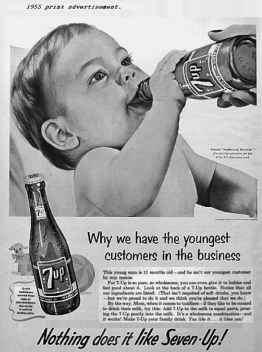
I found a 7UP ad from nearly sixty years ago featuring a baby being fed the soda. The ad proudly boasted that this eleven-month-old was not, “by any means,” their youngest customer. The ad with the image of the happy-faced baby went on with gems like these:

7-Up is so pure, so wholesome you can even give it to babies and feel good about it.

By the way, Mom, when it comes to toddlers—if they like to be coaxed to drink their milk, try this: Add 7-Up to their milk in equal parts, pouring the 7-Up gently into the milk. It’s a wholesome combination—


and it works! (עריכה שלי: הפרסומות עובדות)

“Wholesome combination”? Who are they kidding?

0XSVhCG.jpg


The messages today are subtler, but clearly just as powerful. I remember working in an urgent-care clinic as a resident when a woman came in for an appointment and brought along her seven-month-old baby in a carriage. I saw that the baby was drinking a brown liquid in a baby bottle. I asked the mother what it was and she replied, “Coke.” I asked, “Why are you feeding your baby Coke?!” She said, “Because he likes it!”

Of course he did! He was biologically programmed to love sugar and was already an addict at seven months.

When sugar and junk are promoted and accessible in almost every school in America and in the convenience stores that surround them, can we really blame the kids for tripling the childhood obesity rate over the last few decades and for the epidemic of “adult” onset, or type 2, diabetes in seven-year-olds?

If we are feeding our infants, toddlers, and preteens addictive foods and they go on to become obese teenagers and adults hooked on these foods, how can we blame them for lack of “personal responsibility”? There are 600,000 processed food items in our environment, 80 percent of which contain added sugar. Most people have very little


opportunity to make (or even understand) healthy choices before the food industry influences their palates and their default food choices for a lifetime.

And yet industry and government still love the personal responsibility story. It allows the food industry to push its addictive products without limit and the government to avoid any politically risky social reform. But when companies profit from getting people to consume more and more of their products—products that are designed to light up our brain’s primitive reward center and that have been scientifically proven to cause obesity, heart disease, diabetes, and cancer—we have a problem.

When our government policies and agricultural subsidies have supported the flood of an extra 700 calories per person per day into the food system since 1970 (mostly in the form of high-fructose corn syrup from corn and trans fats), we have a problem.

When government food stamps (the Supplemental Nutrition Assistance Program, or SNAP) pay $4 billion a year for sodas for the poor (29 million servings a day, or 10 billion servings a year) and then the government must pay for the obesity, heart disease, diabetes, and cancer caused by the soda through Medicaid and Medicare, we have a problem.


Taylor Swift promotes Diet Coke, and Kobe Bryant promotes Gatorade. What if celebrities were featured in billion-dollar ad campaigns aimed at getting kids to try crack cocaine or heroin, all with the promise of a better, happier life? We would all be incensed. But that is essentially what’s happening with addictive foods and beverages today in America and, increasingly, around the world.

Nothing less than a comprehensive social and political transformation is needed to hold government and the food and agriculture industries accountable and thus change policy and behavior on a grand scale. We all have to work toward that, and I have outlined many ways to do so in the “Take Back Our Health” section of my book The Blood Sugar Solution, and in Part IV of this book.

But in the meantime, we can’t wait for food companies to act against their own self-interest, or for the government to regulate the food industry’s addictive products and underhanded marketing strategies. We can’t wait to free ourselves from the prison of food addiction.

Yes, the food industry has hijacked our taste buds, our brain chemistry, and our biology, but I will show you the keys to breaking free of cravings and life-destroying food addictions. Think of it as a Navy SEAL raid and recovery mission for your health.

Before we get into the active phase of that mission, though, I want you to really understand the science of food addiction. I want to show you precisely how your biology has been influenced. You’ll likely be astonished! Please try to read these chapters before diving in. The more aware you are of the biological forces at play—both in terms of how your cravings have been chemically induced and of how easy it is break free—the more you’ll get out of this program. You’ll understand not only why this detox works the magic it does, but how to ensure that you never again fall prey to the manipulation of the food industry.

Even more, I’ll present to you the overwhelming evidence that being overweight is not your fault. Clearly seeing and owning up to your powerlessness in the face of an addiction is the first step of any twelve-step program. We have to start there. Then we can heal.


ציטוט:
What I always hated about diets was that I had to think about food every minute of the day. I watched thin people and how they interacted with food, but I was never able to really apply it to my life until now. Now I eat when I’m hungry. I know what’s good for me and I eat those foods, and when I’m done, I stop. That’s how people without weight issues go about their days. I’m no longer consumed by “Should I eat this, can I eat that?” Now I can think about other things in my life besides food. I love good food, but I’m not consumed by it. That to me is living.

You don’t get fat without thinking about how and why. I have had a lot of time to think about what works and what doesn’t work, and this program seems different to me because it’s freeing. People are slaves to food in so many ways in our society, and it’s awful. It’s so liberating to see that we really can break free of that control.

—JACKIE WOODS


THE SCIENCE OF FOOD ADDICTION

A little earlier, I mentioned Kelly Brownell, PhD, the former director of the Yale Rudd Center for Food Policy and Obesity. Dr. Brownell recently sent me a copy of his new textbook, Food and Addiction, A Comprehensive Handbook. For the first time, it assembles all the latest research into one comprehensive volume on how food addiction is the central driver of obesity and related diseases in our society. I want to share some of Dr. Brownell’s most startling findings with you.

Let’s break this down into two parts: how food addiction affects our behavior and how it affects our biology.

Food Addiction and Behavior (or Why “You Can’t Eat Just One”)


ציטוט
I was a sugar and carbohydrate addict. I couldn’t go a day without something sugary. I was like a vampire… I had to have it! I sensed, though, that if I could go a few days without it, I could get past it.

I started the 10-Day Detox and was surprised that I didn’t crave sugar. But the way the food plan was designed, I didn’t feel hungry or anxious in any way. I was calm, the food was good, and I didn’t miss the bad stuff I was eating.

Every day I was on the program I felt more in control… that the food wasn’t in control. Before, I used to think, “I know eating this food is bad for me, I know I shouldn’t have it, and yet I can’t NOT have it.” I couldn’t stop. I didn’t understand that the food literally had physical control over me and that my willpower—even though I had it—wasn’t enough. I didn’t realize that I was so entrenched in the addiction of the processed foods. They’re right with that commercial, you can’t have just one! You’re sitting there eating it, knowing you shouldn’t, yet you cannot stop. I noticed right away that I felt like I was in control over the food, and that was a huge shift.

—JACKIE WOODS


Just as with any other addictive drug, sugar and processed foods cause a temporary high followed by a crash,


leading to a vicious cycle of abuse. Food addicts, the research shows, are no different from alcoholics or cocaine addicts. Their lives become increasingly out of control. As their health deteriorates, they gain weight, suffer from arthritis, have trouble getting around or just tying their shoes, and eventually get high blood pressure, diabetes, heart attacks, strokes, and even dementia and depression.


Disordered eating behavior interferes with work or school and family activities. Think about it: It’s nearly impossible to focus on your work if you’re consumed by thoughts of raiding your colleague’s candy dish. It’s tough to enjoy a family holiday party with your brain screaming at you to go get another handful of chips and dip.

Despite wanting to change or stop, those with food addiction cannot resist—even in the face of significant emotional or physical harm to themselves and those they love. They hide their addiction, they worry and obsess about cutting down, all against a backdrop of shame, embarrassment, and denial. They eat a whole sheet cake in the middle of the night in the dark. They say, “It’s like someone takes over my body and I can’t stop eating. I want to be locked up. I can’t keep living this way.”

The bottom line is this: Your biology controls your behavior, not the other way around. Yes, if you willfully decide to eat three packages of Oreo cookies, your biology will change. But for most of us, most of the time, our biochemistry dictates our behavior.

Our automatic behaviors are controlled by our primitive brain, the neurological machine we have in common with dinosaurs and other reptiles. These automatic behaviors include eating, our fight-or-flight response, and reproduction. This explains why we have so much trouble with food and relationships! According to the primitive brain, survival depends on our avoiding pain (danger) and seeking pleasure (sustenance and safety). When we have a life trauma, this part of our brain is on high alert, making us hypervigilant and protecting us against future threats. This mechanism is so powerful that it can even trigger full-blown post-traumatic stress disorder.

When our brains are bombarded with sugar, a potent pleasure inducer, we become addicted to that pleasure. Willpower and conscious choice are no match for these powerful, ancient drives for survival.

Food Addiction and Biology (aka Stop Blaming Yourself!)

Here’s where things get interesting. A 2009 study by Dr. Serge H. Ahmed, Is Sugar as Addictive as Cocaine?,published in the journal Food and Addiction, proved that sugar was eight times as addictive as cocaine. When I first read this, it was hard for me to believe. But this carefully designed study found that when rats were offered intravenous cocaine or sugar (in the form of artificially sweetened water), they always went for the sugar. Even previously cocaine-addicted rats switched to the sweetened water. When higher and higher doses of cocaine were injected intravenously, just below the amount that would give them seizures, they still went for the sweetened water.

Think about it. The rats preferred the equivalent of a Diet Coke to being shot up with intravenous cocaine. Sugary sweetness (in this case created by artificial sweeteners) has a stronger draw than even heroin, which is much more addictive than cocaine. Other studies comparing table sugar and cocaine found the same results, including one done at Connecticut College that showed that rats who were fed Oreo cookies had significantly greater activity


in the pleasure center of their brains than those who were injected with cocaine or morphine. And yes, this is an animal study, and rats and humans are different, but the same types of results have been found in human studies.

As I just explained, we are hardwired to seek pleasure and reward. It is a survival mechanism. Anytime we have access to hyperpalatable sweet or fatty foods, we are programmed to eat a lot of them and to store those excess calories as belly fat to sustain us through scarce times that may lie ahead. That’s what your body is supposed to do; the problem is that the scarcity we’re storing up for never comes. The diabesity epidemic is really just a normal biological response to the inputs from our abnormal environment. What saved us as hunter-gatherers is killing us now.

You’re probably wondering why we don’t have a built-in control mechanism to tell the brain we have had enough food. We do. Your body’s natural brake on hunger is a hormone produced by your fat cells called leptin. Unfortunately, in many of us, that natural brake line has been tampered with.

Two bad things happen when your biology is damaged by sugar and processed foods. First, your body becomes insulin resistant, so you have to pump out more and more insulin in an attempt to keep your blood sugar normal. Insulin is a powerful fat-storage hormone, one that encourages your body to pack on dangerous belly fat.

Second, you become leptin resistant. That means that no matter how much of this fabulous appetite-suppressing hormone your body makes, your brain cannot read the signals. It is “resistant,” or numb, to the signals from leptin. But wait… it gets worse.

High levels of insulin produced through all the sugar and fructose consumption (from high-fructose corn syrup and other sugars) block the leptin signals in your brain, so your body thinks it is starving even after a Big Mac, fries, and a large soda. Ever wonder how you can still be hungry right after a big meal? It is the insulin surge and the leptin resistance. This is how sugar and junk food hijack your brain chemistry and your metabolism.

Unfortunately, the story doesn’t end there. The fructose (mostly from high-fructose corn syrup) gets directly absorbed from your gut and goes to the liver without passing through the normal controls that glucose has to deal with. Insulin is required to get glucose into the cells, but fructose gets mainlined directly into the liver. This switches on lipogenesis, the mechanism that turns sugar directly into fat. Think fatty liver. Think foie gras—not in a goose, but in you.

A fatty liver is an inflamed liver. This, in turn, causes even more insulin resistance. Your cells become numb to the effects of insulin, but your body desperately wants to get the sugar into your cells. The body then pumps out more insulin, creating more belly fat and inflammation. This is the cause of most heart attacks and strokes, many cancers, and even dementia. In fact, insulin resistance is the very cause of aging itself.

THE PLEASURE CENTER: THE POWER OF SUGAR

Calorie for calorie, sugar is different from other calories that come from protein, fat, or nonstarchy carbs such as greens. As you’ve seen, it scrambles all your normal appetite controls. So you consume more and more, driving your metabolism to convert it into lethal belly fat. There is no doubt about it: By any definition, sugar is a toxin.


Paracelsus, the great medical philosopher, said, “The dose makes the poison.” We are all overdosed at an average of twenty-two teaspoons of sugar a day per person in America.

Remember the milk shake study? Sugar lights up the pleasure center in the brain and releases dopamine, the “feel-good” chemical. It works on the same parts of the brain as cocaine or heroin, but it is much worse. When researchers provide direct electrical stimulation of the reward centers in the brains of rats, they still can’t compete with sugar water. Cocaine lights up only one part of the brain, while sugar lights it up like fireworks on Independence Day!

Brain imaging studies in humans find the same thing. Eating—or even seeing pictures of—junk and processed food lights up the brain like heroin. People say they gain weight just by looking at a donut. They may actually be right, because the body pumps out insulin in response to even the thought of something sweet.

When you continue to “use” sugar and processed foods, your dopamine receptors are decreased. That means you need more and more of the addictive substance to generate the same amount of pleasure. This dynamic is called tolerance. It explains why a light or occasional drinker, like me, might feel significant effects from a single alcoholic drink, while a heavy drinker or an alcoholic may need to drink a fifth of vodka just to get a buzz.

When food addicts try to “quit,” they get withdrawal symptoms lasting up to seven days, including nausea, headaches, shakiness, disorientation, fatigue, cravings, irritability, disturbed sleep, and nightmares. (Don’t worry—these symptoms are much less challenging and last for a shorter time when you follow the 10-Day Detox Diet.)

For many, even gastric bypass cannot overcome this addiction. One patient of mine lost 200 pounds through gastric bypass and ate his way back to obesity through a constant stream of M&M’s. Too often, gastric bypass fails because it doesn’t fix the underlying biology of food addiction.


The Special Case of High-Fructose Corn Syrup

In his book Fat Chance, Dr. Robert Lustig calls fructose “the toxin” because it is qualitatively different from other sugars. When fructose occurs naturally, as it does in fruit, with fiber and other nutrients, and when not consumed in excessive quantities, it is fine. But strip fructose out of corn, throw it into a new stew of “free” fructose comprising 55 to 75 percent of the high-fructose corn syrup in sodas (table sugar is 50/50 fructose and glucose), and you have the disaster that is the obesity epidemic.

The high-fructose corn syrup (HFCS) in most of these drinks is worse than regular sugar, despite the propaganda in the multimillion-dollar ad campaign from the Corn Refiners Association rebranding HFCS as natural “corn sugar.” The fructose doesn’t provide the same feedback control on appetite as regular sugar, making the addiction worse. It fact, it leads to a blocking of the appetite-control hormones, especially leptin, the hormone that tells your brain you are full. So you continue to eat and eat, crave and crave, and your body thinks you are starving even though you are drowning in calories. HFCS is the number one source of calories in our diet. As an extra “bonus,” high-fructose corn syrup often contains mercury as a by-product of processing.

New research from Dr. Bruce Ames, professor emeritus of biochemistry and molecular biology at the University of California, Berkeley, shows that the free fructose in HFCS causes a leaky gut. Little Lego-like attachments called tight junctions hold the cells


of the intestinal lining together. These attachments require energy to stick together. When you eat or drink HFCS, it requires more energy to be absorbed into the body than regular sugar, which depletes the energy supply in the intestinal lining, so those attachments weaken. Food proteins and bacterial toxins then “leak” into your bloodstream through the wall of your intestines, causing your immune system to go into gear and produce system-wide inflammation. The inflammation, in turn, triggers more insulin resistance, weight gain, and diabetes.

So you see, HFCS is not just like regular sugar. It has dangerous effects on the body that drive more inflammation, more obesity and diabetes, and more addiction.

LIQUID SUGAR CALORIES (AKA LIQUID DEATH): WHY THEY ARE DIFFERENT FROM REGULAR SUGAR
Remember the rat study? It showed us that sugar-sweetened water (whether sweetened with high-fructose corn syrup or artificial sweeteners) is eight times more addictive than cocaine. Even more than junk food, fast food, or processed carbs such as bread and pasta or chips, sweet drinks have super-addictive properties. While regular old sugary or starchy food will still cause cravings and addiction, the liquid stuff wreaks even more havoc.

It’s easy not to notice all those empty calories hidden in sweet drinks. Drinks don’t fill you up, which is why, if you include sugar-sweetened and artificially sweetened drinks, you end up eating more total calories in a day. They are easy to consume without thinking about it; we call that passive consumption. They are just drinks, after all. But they add up fast and crowd out real food from your diet. Plus, artificially sweetened drinks jack up your cravings, driving you to eat more food over the course of the day.

Liquid sugar is absorbed very quickly, driving up blood sugar and insulin and mainlining fructose to your liver, setting off a cascade of events that causes weight gain and more cravings. When your insulin spikes and your blood sugar drops, your body sees it as a life-threatening emergency, so you are driven to go looking for your next sugar fix.

It’s not just soda we have to worry about, but also sports drinks, sweetened teas and coffees, energy drinks, fruit drinks, and hundreds of other sugary drinks. Ounce per ounce, orange juice has more sugar than cola. If you consume these highly sweetened drinks, your taste buds become adapted to this high-intensity sweetness, and other real, whole food such as vegetables or fruit tastes bland and boring.

Fully 90 percent of kids and 50 percent of the US population drinks soda once a day. One billion cans of Coke are consumed daily around the world. In a review of all the relevant research, scientists found that the number one cause of obesity is sugar-sweetened beverages. One can of soda a day increases a kid’s chance of obesity by 60 percent, and in a study of more than 90,000 women, one soda a day increased the risk of diabetes by 82 percent.

One young woman with eight kids from New Zealand had a bad Coke habit. It killed her. She drank 2.2 gallons a day, or 2 pounds of sugar and 900 milligrams of caffeine. Autopsy reports show she died of a fatty liver and heart damage from the Coke. Though the American Beverage Association would have us think otherwise, sugar-sweetened drinks are a major contributor to our big fat problem.


Considering that 15 percent of our calories come from sweetened beverages, cutting them out is an easy way to dramatically improve your health. One patient of mine lost seventy-five pounds just by becoming aware of and cutting out his liquid sugar calories.

WHY NOT SWITCH TO ARTIFICIAL SWEETENERS?

Diet soda and diet drinks make you fat and cause type 2 diabetes.

Wait… diet soda makes people fat? Really? How does that happen?

If losing weight were all about the calories, then consuming diet drinks would seem like a good idea. That’s certainly what Coca-Cola wants us to believe, judging by its ad campaigns highlighting its efforts to fight obesity. (And the other food giants making diet drinks push the same propaganda.) Coke proudly promotes the fact that it has 180 low- or no-calorie drinks and that it has cut sales of sugared drinks in schools by 90 percent.

Is that a good thing? I don’t think so. In fact, it may be worse to drink diet soda than regular soda. A fourteen-year study of 66,118 women published in the American Journal of Clinical Nutrition (and supported by many previous and subsequent studies) discovered some frightening facts that should make us all swear off diet drinks and products:

Diet sodas raised the risk of diabetes more than sugar-sweetened sodas.


Women who drank one twelve-ounce diet soda a week had a 33 percent increased risk of type 2 diabetes, and women who drank one twenty-ounce soda a week had a 66 percent increased risk.

Women who drank diet sodas drank twice as much as those who drank sugar-sweetened sodas because artificial sweeteners are more addictive than regular sugar.

The average diet soda drinker consumes three diet drinks a day.

Let me lay out a few more of the evils of artificial sweeteners, just in case you’re not yet convinced:

Artificial sweeteners are hundreds to thousands of times sweeter than regular sugar, activating our genetically programmed preference for sweetness more than any other substance.

Artificial sweeteners trick your metabolism into thinking sugar is on its way. This causes your body to pump out insulin, the fat-storage hormone, which leads to more belly fat.

Artificial sweeteners confuse and slow down your metabolism, so you burn fewer calories every day. They make you hungrier and cause you to crave even more sugar and starchy carbs, such as bread and pasta.

In animal studies, the rats that consumed artificial sweeteners ate more food, their metabolic fire or thermogenesis slowed down, and they put on 14 percent more body fat in just two weeks—even if they ate fewer total calories than the rats that ate regular sugar-sweetened food.

The bottom line is that there is no free ride. Diet drinks are not good substitutes for sugar-sweetened drinks.


They increase cravings, weight gain, and type 2 diabetes. And they are addictive.

THE WAY OUT

The evidence for biological addiction is overwhelming. You may be saying, “No, not me… I can control my eating. I can handle having some sugar or cookies. It really isn’t affecting my life that much.”

This is called denial. Food addiction affects more than just a few of the massively obese. It affects nearly all those who are overweight or have struggled to control their eating behavior, cravings, and appetite. The diagnostic criteria for substance abuse in the DSM-V (the psychiatry handbook) match exactly the behavioral characteristics of food addiction, including:

1. Tolerance, the need for increasing amounts of the substance to feel anything (needing more and more to feel good).

2. Withdrawal symptoms from not having the substance.

3. Ingesting larger amounts or over a longer period than intended (bingeing).

4. Persistent desire and unsuccessful attempts to cut down (guilt and shame).

5. Spending a great deal of time to obtain the substance, use the substance, and recover from its effects.

6. Reducing or abandoning significant social, work, or recreational activities.

7. Continuing to use despite awareness of persistent physical or psychological problems that result.

Is there a way out of food addiction? A way to free yourself from the control that processed food and sugar have over your behavior and well-being?

Yes. If we can agree that there is biological addiction, then the only solution is to detox to break the cycle. Try asking a cocaine or heroin addict to “cut down.” Forget it. I wish it weren’t so, but I am simply the messenger for the science of food addiction. This is why I decided to write this book: to give people powerful tools to painlessly detox from sugar and processed food and reset, reboot, and restore their body to health.


ערכיה שלי: מיתוס - כל הקלרויות הם נוצרו אותו דבר

MYTH #1: ALL CALORIES ARE CREATED EQUAL

Take a class of sixth graders. Show them a picture of 1,000 calories of broccoli and 1,000 calories of soda. Ask them if they have the same effect on our bodies. Their unanimous response will be “NO!” We all intuitively know that equal caloric amounts of soda and broccoli can’t be the same nutritionally. But as Mark Twain said, “The problem with common sense is that it is not too common.”

I guess that is why the medical profession, nutritionists, our government, the food industry, and the media are all still actively promoting the outdated, scientifically disproven idea that all calories are created equal. Yes, that well-worn notion—that as long as you burn more calories than you consume, you will lose weight—is simply dead wrong.

Newton’s first law of thermodynamics states that the energy of an isolated system is constant. In other words, in a laboratory, or “isolated system,” 1,000 calories of broccoli and 1,000 calories of soda are, in fact, the same. I’m not saying Newton was wrong about that. It’s true that when burned in a laboratory setting, 1,000 calories of broccoli and 1,000 calories of soda would indeed release the same amount of energy.

But sorry, Mr. Newton; your law of thermodynamics doesn’t apply in living, breathing, digesting systems. When you eat food, the “isolated system” part of the equation goes out the window. The food interacts with your biology, a complex adaptive system that instantly transforms every bite.

To illustrate how this works, let’s follow 750 calories of soda and 750 calories of broccoli once they enter your body. First, soda: 750 calories is the amount in a Double Gulp from 7-Eleven, which is 100 percent sugar and contains 186 grams, or 46 teaspoons, of sugar. Many people actually do consume this amount of soda. They are considered the “heavy users.”

Your gut quickly absorbs the fiber-free sugars in the soda, fructose, and glucose. The glucose spikes your blood sugar, starting a domino effect of high insulin and a cascade of hormonal responses that kicks bad biochemistry into gear. The high insulin increases storage of belly fat, increases inflammation, raises triglycerides and lowers HDL, raises blood pressure, lowers testosterone in men, and contributes to infertility in women.

Your appetite is increased because of insulin’s effect on your brain chemistry. The insulin blocks your


appetite-control hormone leptin. You become more leptin resistant, so the brain never gets the “I’m full” signal. Instead, it thinks you are starving. Your pleasure-based reward center is triggered, driving you to consume more sugar and fueling your addiction.

The fructose makes things worse. It goes right to your liver, where it starts manufacturing fat, which triggers more insulin resistance and causes chronically elevated blood insulin levels, driving your body to store everything you eat as dangerous belly fat. You also get a fatty liver, which generates more inflammation. Chronic inflammation causes more weight gain and diabesity. Anything that causes inflammation will worsen insulin resistance. Another problem with fructose is that it doesn’t send informational feedback to the brain, signaling that a load of calories just hit the body. Nor does it reduce ghrelin, the appetite hormone that is usually reduced when you eat real food.

Now you can see just how easily 750 calories of soda can create biochemical chaos. In addition, the soda contains no fiber, vitamins, minerals, or phytonutrients to help you process the calories you are consuming. These are “empty” calories devoid of any nutritional value. But they are “full” of trouble. Your body doesn’t register soda as food, so you eat more all day long. Plus, your taste buds get hijacked, so anything that is not super-sweet doesn’t taste very good to you.

Think I’m exaggerating? Cut out all sugar for a week, then have a cup of blueberries. Super-sweet. But eat those same blueberries after bingeing on soda and they will taste bland and boring.

Now let’s look at the 750 calories of broccoli. As with the soda, these calories are made up primarily (although not entirely) of carbohydrates—but let’s clarify just what that means, because the varying characteristics of carbs will factor significantly into the contrast I’m about to illustrate.

Carbohydrates are plant-based compounds comprised of carbon, hydrogen, and oxygen. They come in many varieties, but they are all technically sugars or starches, which convert to sugar in the body. The important difference is in how they affect your blood sugar. High-fiber, low-sugar carbohydrates such as broccoli are slowly digested and don’t lead to blood sugar and insulin spikes, while table sugar and bread are quickly digested carbs that spike your blood sugar. Therein lies the difference. Slow carbs like broccoli heal rather than harm.

Those 750 calories of broccoli make up 21 cups and contain 67 grams of fiber (the average American consumes 10 to 15 grams of fiber a day). Broccoli is 23 percent protein, 9 percent fat, and 68 percent carbohydrate, or 510 calories from carbs. The “sugar” in 21 cups of broccoli is the equivalent of only 1.5 teaspoons; the rest of the carbohydrates are the low-glycemic type found in all nonstarchy vegetables, which are very slowly absorbed.

Still, are the 750 calories in broccoli really the same as the 750 calories in soda? Kindergarten class response: “No way!” So why do we all think that’s true, and why has every major governmental and independent organization bought into this nonsense?

Let’s take a closer look at just how different these two sets of calories really are.

First, you wouldn’t be able to eat twenty-one cups of broccoli, because it wouldn’t fit in your stomach. But assuming you could, what would happen? They contain so much fiber that very few of the calories would actually get absorbed. Those that did would get absorbed very slowly. There’d be no blood sugar or insulin spike, no fatty liver, no hormonal chaos. Your stomach would distend (which it doesn’t with soda; bloat from carbonation doesn’t count!), sending signals to your brain that you were full. There would be no triggering of the addiction reward

center in the brain. You’d also get many extra benefits that optimize metabolism, lower cholesterol, reduce inflammation, and boost detoxification. The phytonutrients in broccoli (glucosinolates) boost your liver’s ability to detoxify environmental chemicals, and the flavonoid kaempferol is a powerful anti-inflammatory. Broccoli also contains high levels of vitamin C and folate, which protect against cancer and heart disease. The glucosinolates and sulphorophanes in broccoli change the expression of your genes to help balance your sex hormones, reducing breast and other cancers.

What I’m trying to illustrate here (and this is probably the single most important idea in this book) is that all calories are NOT created equal. The same number of calories from different types of food can have very different biological effects.

Some calories are addictive, others healing, some fattening, some metabolism-boosting. That’s because, as you’ll read in “Myth #2” below, food doesn’t just contain calories, it contains information. Every bite of food you eat broadcasts a set of coded instructions to your body—instructions that can create either health or disease.

So what will it be, a Double Gulp or a big bunch of broccoli?


Soda and Diabetes

If you still think a calorie is just a calorie, maybe this study will convince you otherwise. In a study of 154 countries that looked at the correlation of calories, sugar, and diabetes, scientists found that adding 150 calories a day to the diet barely raised the risk of diabetes in the population, but if those 150 calories came from soda, the risk of diabetes went up by 700 percent.
 
נערך לאחרונה:
אתה טועה לגביי השמנת יתר בארצות הברית, אתה בעצם מאשים את האנשים פה ולא את הממשלה כשהם מאשרים
כל דבר מסוכן לבריאות ומשמין, The EU Has Banned Over 1000 Chemicals; The FDA Has Only Banned 9
שמים מקדונלדס בכל פינה, מפרסמים ושמים המון כסף על פרסומות JUNK בטלויזיה, שיכול להיות מסוכן לילדים קטנים, כשהם נכנסים לחנות הם בוחרים דברים שהם ראו בפרסומת. תאמין או לא תעשיית המזון, שוכרת מומחים לתשוקת אוכל בשביל שהואכל יהיה ממכר, כשתגע בזה, זה ישחרר
רמות גבוהות של דופמין (נאורוטרנסמיטר האחראי על מוטיבציה, רצון לעסוק בחיים, תגמול ועוד), שתאכל עוד ועוד.

תקרא את הספר The blood sugar solution 10-day detox diet על ידיי רופא גדול באמריקה מספר למה אנשים שמנים ולמה יש המון מחלות בארצות הברית בצורה מפחידה.

ותחולת החיים יותר גדולה עכשיו? לפני 100 שנה היה יותר קל למות מכדור מאשר למות מסרטן כי כמעט זה לא היה.
וגם אוטיזם זה היה נדיר ולמה שהו אחרי מלחמת העולם זה התחיל לגדול בצרות מטורפות אחרי שפיתחו את האנטיביוטיקה והתחילו לתת חיסונים לילדים קטנים (שמכילים כספית). וגם לא היו כמעט שמנים בארצות הברית לפני 50 או 100 שנה בערך, זה הולך וגדל. תודות לממשלה, ל FDA, מונסטו ועוד.

והתכוונתי ל High fructose corn syrup לא סוכר של פירות. שזה בהרבה יותר גרוע מסכור רגיל. ואתה טועה לגביי שסוכר של פירות מעלה את רמות הכולסטרול הרע LDL, אמא שלי אוכלת המון פירות כל יום, לפחות 15+ או 10. ב 30.11.2015 אני והיא עשינו בדיקת דם לא בגלל כולסטרול LDL, אבל אחרי 5 שנה עם אכילת פירות בצורה גבוהה ה LDL שלה הוא מאוד נמוך 85.30 מ"ג לכל דציליטר
DSSS1zf.jpg


גם לא כל הקלרויות נוצרו שווים. הכי למטה בספר, יש הסבר.

קטעים מהספר The blood sugar solution
מסביר למה זה ככה בארצות הברית

אם אתה שואל אם קראתי את כל זה, אז כן, פעמיים את כל הספר וגם עכשיו בשביל רענון, דברים חשובים שסימנתי על ידיי עצמי סימנתי בעבה ירוק

HOW DID WE GET HERE?

Governments, the United Nations, the Institute of Medicine, and the World Health Organization are all struggling to solve this big fat problem, which accounts for 80 percent of our health care costs and will create a global price tag of $47 trillion over the next twenty years. The National Institutes of Health spends $800 million a year trying to find the “cause” of obesity. Yet despite all this attention, we are still failing.

The causes are multiple, and it’s easy to point fingers. Big Food blames lack of exercise and our sedentary lifestyle. Parents blame schools, and schools blame parents. The government won’t blame anyone, for fear of losing lobbying and campaign dollars.

The food industry would have us believe obesity is the result of personal choices. Its implication: People are fat because they are lazy and gluttonous, not because their biology has been masterfully tricked into craving the toxins that these industries produce. If we all just took more personal responsibility, the industry’s paid experts assert, we could solve this problem. There are no good or bad foods, they claim; it’s all about moderation. And of

course, we should all just exercise a bit more. What they don’t explain is that you would have to walk four and a half miles to burn off one twenty-ounce soda. To burn off just one supersize fast-food meal, you’d have to run four miles a day, every day, for a week. Oh, and thanks to the addiction-generating genius of fast-food engineering, once you’ve eaten that supersize meal, you’re going to want another one—soon.

It’s true that finger-pointing isn’t necessarily going to solve the problem. But I think it’s important for us all to understand that the real blame for our weight and health problems lies less with the individuals who’ve inadvertently become addicted to processed foods than with the food companies that designed food products with highly addictive properties in the first place.

BIG FOOD: THE DRUG PUSHERS

The last few decades have seen the emergence of a whole new breed of mad “food scientists.” Their job is to invent addictive, hyperpalatable processed and junk foods to ensure that their employers (Big Food) get the biggest market share, or what industry insiders call stomach share.

Food scientists focus on creating foods that maximally trigger the “bliss point,” that addictive reward pathway in the brain that keeps you coming back for more. They chemically exaggerate certain flavors while suppressing others and alter the chemical structure of fats to enhance the “mouth feel.” Their goal: to create a taste sensation so intoxicatingly appealing that no matter how much you eat, you feel you can never get enough.

If the food industry just happened to accidentally create addictive products in an earnest attempt to improve their recipes, we could understand that and expect them to correct their mistake. But these foods happen by design, not by accident.

Big Food spends millions on food science and hires “craving experts” to ensure that its customers will become addicted to deviously developed drugs, all of which are hidden in cleverly disguised delivery vehicles for sugar, fat, and salt. Think heroin lollipops.

You might think I’m paranoid, overstating the case. But in his book Salt Sugar Fat, Pulitzer Prize–winning investigative reporter Michael Moss pulls back the veil on Big Food, using meticulous firsthand interviews and research into secret company documents to reveal just how strategically Big Food has altered our food supply to our detriment. Moss points the finger at virtually all the big boys in Big Food and their products, including Kraft, Coca-Cola, Lunchables, Kellogg, Nestlé, Oreos, Cargill, and Capri Sun. (About twelve companies control almost all of the $1-trillion food industry. Frighteningly, they have now also bought up most of the natural and organic food companies.)

Big Food markets the foods just the way Big Tobacco marketed cigarettes, making them “healthier” with come-ons like low tar and nicotine. They might label foods as low-fat or low-salt, but they are hardly healthy, and most still qualify as addictive Frankenfoods. Don’t be fooled. Even a serving of Prego tomato sauce has two teaspoons of sugar, more than two Oreo cookies.

The leading food companies target kids, who can’t tell the difference between a TV commercial and a regular
show until they are around eight years old. The average two-year-old who is still just learning to talk can cry out in a supermarket for specific brands he or she has seen on television ads.
That’s scary, because most of the cereals marketed to kids are three-quarters sugar, even the “whole-grain” ones. It is not breakfast. It is dessert! The cereal manufacturers just added “whole grains” when the government recommended we eat more whole grains. Good marketing doesn’t make bad food better. It’s still a wolf in sheep’s clothing. The food is intentionally manipulated to create cravings and addiction. The industry even refers to those of you who buy a lot of their products as heavy users. They know their products are addictive. Now you do, too.

THE PERSONAL RESPONSIBILITY PROPAGANDA

The mantra of the government and food industry is that people should just eat less, choose a “balanced diet,” and exercise more. How’s that working out for you?

Food addiction is a biochemical problem, not an emotional one. It makes me furious to see patient after patient blame himself or herself for his or her weight problems and diabesity. Yes, we all have choices, and personal empowerment and responsibility are important, but they are not enough if we are trapped in a food coma induced by the toxic influences of sugar and processed foods.

No one chooses to be fat. If you grew up not being able to identify a vegetable because you never ate one, if your school had only deep-fried food out of a box or a can and was stocked with vending machines full of sweetened sports drinks, juices, or sodas, or was ringed by convenience stores where you could buy a sixty-four-ounce Big Gulp on your way home every day, it’s no surprise that your habits and taste buds got wired that way.

If nearly every restaurant chain near you serves jumbo portions of sugar and fat and salt, if your workplace lunchroom is a toxic food dump, good luck staying healthy. If, unbeknownst to you, your yogurt contains more sugar than a Coke, and the main ingredient in your barbecue sauce is high-fructose corn syrup, how can the food industry point the finger at you for not taking personal responsibility?

Peer pressure to fit in is strong, and Big Food knows this. Big Food preys on people’s desire to be eating and drinking the “in” thing and uses manipulation to get customers hooked. Remember the Coca-Cola ad, “I’d like to buy the world a Coke”? Let’s get the whole world hooked! Now North Korea and Cuba are the only countries to which Coke is not distributed. Mission accomplished!

I found a 7UP ad from nearly sixty years ago featuring a baby being fed the soda. The ad proudly boasted that this eleven-month-old was not, “by any means,” their youngest customer. The ad with the image of the happy-faced baby went on with gems like these:

7-Up is so pure, so wholesome you can even give it to babies and feel good about it.

By the way, Mom, when it comes to toddlers—if they like to be coaxed to drink their milk, try this: Add 7-Up to their milk in equal parts, pouring the 7-Up gently into the milk. It’s a wholesome combination—


and it works! (עריכה שלי: הפרסומות עובדות)

“Wholesome combination”? Who are they kidding?

0XSVhCG.jpg


The messages today are subtler, but clearly just as powerful. I remember working in an urgent-care clinic as a resident when a woman came in for an appointment and brought along her seven-month-old baby in a carriage. I saw that the baby was drinking a brown liquid in a baby bottle. I asked the mother what it was and she replied, “Coke.” I asked, “Why are you feeding your baby Coke?!” She said, “Because he likes it!”

Of course he did! He was biologically programmed to love sugar and was already an addict at seven months.

When sugar and junk are promoted and accessible in almost every school in America and in the convenience stores that surround them, can we really blame the kids for tripling the childhood obesity rate over the last few decades and for the epidemic of “adult” onset, or type 2, diabetes in seven-year-olds?

If we are feeding our infants, toddlers, and preteens addictive foods and they go on to become obese teenagers and adults hooked on these foods, how can we blame them for lack of “personal responsibility”? There are 600,000 processed food items in our environment, 80 percent of which contain added sugar. Most people have very little


opportunity to make (or even understand) healthy choices before the food industry influences their palates and their default food choices for a lifetime.

And yet industry and government still love the personal responsibility story. It allows the food industry to push its addictive products without limit and the government to avoid any politically risky social reform. But when companies profit from getting people to consume more and more of their products—products that are designed to light up our brain’s primitive reward center and that have been scientifically proven to cause obesity, heart disease, diabetes, and cancer—we have a problem.

When our government policies and agricultural subsidies have supported the flood of an extra 700 calories per person per day into the food system since 1970 (mostly in the form of high-fructose corn syrup from corn and trans fats), we have a problem.

When government food stamps (the Supplemental Nutrition Assistance Program, or SNAP) pay $4 billion a year for sodas for the poor (29 million servings a day, or 10 billion servings a year) and then the government must pay for the obesity, heart disease, diabetes, and cancer caused by the soda through Medicaid and Medicare, we have a problem.


Taylor Swift promotes Diet Coke, and Kobe Bryant promotes Gatorade. What if celebrities were featured in billion-dollar ad campaigns aimed at getting kids to try crack cocaine or heroin, all with the promise of a better, happier life? We would all be incensed. But that is essentially what’s happening with addictive foods and beverages today in America and, increasingly, around the world.

Nothing less than a comprehensive social and political transformation is needed to hold government and the food and agriculture industries accountable and thus change policy and behavior on a grand scale. We all have to work toward that, and I have outlined many ways to do so in the “Take Back Our Health” section of my book The Blood Sugar Solution, and in Part IV of this book.

But in the meantime, we can’t wait for food companies to act against their own self-interest, or for the government to regulate the food industry’s addictive products and underhanded marketing strategies. We can’t wait to free ourselves from the prison of food addiction.

Yes, the food industry has hijacked our taste buds, our brain chemistry, and our biology, but I will show you the keys to breaking free of cravings and life-destroying food addictions. Think of it as a Navy SEAL raid and recovery mission for your health.

Before we get into the active phase of that mission, though, I want you to really understand the science of food addiction. I want to show you precisely how your biology has been influenced. You’ll likely be astonished! Please try to read these chapters before diving in. The more aware you are of the biological forces at play—both in terms of how your cravings have been chemically induced and of how easy it is break free—the more you’ll get out of this program. You’ll understand not only why this detox works the magic it does, but how to ensure that you never again fall prey to the manipulation of the food industry.

Even more, I’ll present to you the overwhelming evidence that being overweight is not your fault. Clearly seeing and owning up to your powerlessness in the face of an addiction is the first step of any twelve-step program. We have to start there. Then we can heal.


ציטוט:
What I always hated about diets was that I had to think about food every minute of the day. I watched thin people and how they interacted with food, but I was never able to really apply it to my life until now. Now I eat when I’m hungry. I know what’s good for me and I eat those foods, and when I’m done, I stop. That’s how people without weight issues go about their days. I’m no longer consumed by “Should I eat this, can I eat that?” Now I can think about other things in my life besides food. I love good food, but I’m not consumed by it. That to me is living.

You don’t get fat without thinking about how and why. I have had a lot of time to think about what works and what doesn’t work, and this program seems different to me because it’s freeing. People are slaves to food in so many ways in our society, and it’s awful. It’s so liberating to see that we really can break free of that control.

—JACKIE WOODS


THE SCIENCE OF FOOD ADDICTION

A little earlier, I mentioned Kelly Brownell, PhD, the former director of the Yale Rudd Center for Food Policy and Obesity. Dr. Brownell recently sent me a copy of his new textbook, Food and Addiction, A Comprehensive Handbook. For the first time, it assembles all the latest research into one comprehensive volume on how food addiction is the central driver of obesity and related diseases in our society. I want to share some of Dr. Brownell’s most startling findings with you.

Let’s break this down into two parts: how food addiction affects our behavior and how it affects our biology.

Food Addiction and Behavior (or Why “You Can’t Eat Just One”)


ציטוט
I was a sugar and carbohydrate addict. I couldn’t go a day without something sugary. I was like a vampire… I had to have it! I sensed, though, that if I could go a few days without it, I could get past it.

I started the 10-Day Detox and was surprised that I didn’t crave sugar. But the way the food plan was designed, I didn’t feel hungry or anxious in any way. I was calm, the food was good, and I didn’t miss the bad stuff I was eating.

Every day I was on the program I felt more in control… that the food wasn’t in control. Before, I used to think, “I know eating this food is bad for me, I know I shouldn’t have it, and yet I can’t NOT have it.” I couldn’t stop. I didn’t understand that the food literally had physical control over me and that my willpower—even though I had it—wasn’t enough. I didn’t realize that I was so entrenched in the addiction of the processed foods. They’re right with that commercial, you can’t have just one! You’re sitting there eating it, knowing you shouldn’t, yet you cannot stop. I noticed right away that I felt like I was in control over the food, and that was a huge shift.

—JACKIE WOODS


Just as with any other addictive drug, sugar and processed foods cause a temporary high followed by a crash,


leading to a vicious cycle of abuse. Food addicts, the research shows, are no different from alcoholics or cocaine addicts. Their lives become increasingly out of control. As their health deteriorates, they gain weight, suffer from arthritis, have trouble getting around or just tying their shoes, and eventually get high blood pressure, diabetes, heart attacks, strokes, and even dementia and depression.


Disordered eating behavior interferes with work or school and family activities. Think about it: It’s nearly impossible to focus on your work if you’re consumed by thoughts of raiding your colleague’s candy dish. It’s tough to enjoy a family holiday party with your brain screaming at you to go get another handful of chips and dip.

Despite wanting to change or stop, those with food addiction cannot resist—even in the face of significant emotional or physical harm to themselves and those they love. They hide their addiction, they worry and obsess about cutting down, all against a backdrop of shame, embarrassment, and denial. They eat a whole sheet cake in the middle of the night in the dark. They say, “It’s like someone takes over my body and I can’t stop eating. I want to be locked up. I can’t keep living this way.”

The bottom line is this: Your biology controls your behavior, not the other way around. Yes, if you willfully decide to eat three packages of Oreo cookies, your biology will change. But for most of us, most of the time, our biochemistry dictates our behavior.

Our automatic behaviors are controlled by our primitive brain, the neurological machine we have in common with dinosaurs and other reptiles. These automatic behaviors include eating, our fight-or-flight response, and reproduction. This explains why we have so much trouble with food and relationships! According to the primitive brain, survival depends on our avoiding pain (danger) and seeking pleasure (sustenance and safety). When we have a life trauma, this part of our brain is on high alert, making us hypervigilant and protecting us against future threats. This mechanism is so powerful that it can even trigger full-blown post-traumatic stress disorder.

When our brains are bombarded with sugar, a potent pleasure inducer, we become addicted to that pleasure. Willpower and conscious choice are no match for these powerful, ancient drives for survival.

Food Addiction and Biology (aka Stop Blaming Yourself!)

Here’s where things get interesting. A 2009 study by Dr. Serge H. Ahmed, Is Sugar as Addictive as Cocaine?,published in the journal Food and Addiction, proved that sugar was eight times as addictive as cocaine. When I first read this, it was hard for me to believe. But this carefully designed study found that when rats were offered intravenous cocaine or sugar (in the form of artificially sweetened water), they always went for the sugar. Even previously cocaine-addicted rats switched to the sweetened water. When higher and higher doses of cocaine were injected intravenously, just below the amount that would give them seizures, they still went for the sweetened water.

Think about it. The rats preferred the equivalent of a Diet Coke to being shot up with intravenous cocaine. Sugary sweetness (in this case created by artificial sweeteners) has a stronger draw than even heroin, which is much more addictive than cocaine. Other studies comparing table sugar and cocaine found the same results, including one done at Connecticut College that showed that rats who were fed Oreo cookies had significantly greater activity


in the pleasure center of their brains than those who were injected with cocaine or morphine. And yes, this is an animal study, and rats and humans are different, but the same types of results have been found in human studies.

As I just explained, we are hardwired to seek pleasure and reward. It is a survival mechanism. Anytime we have access to hyperpalatable sweet or fatty foods, we are programmed to eat a lot of them and to store those excess calories as belly fat to sustain us through scarce times that may lie ahead. That’s what your body is supposed to do; the problem is that the scarcity we’re storing up for never comes. The diabesity epidemic is really just a normal biological response to the inputs from our abnormal environment. What saved us as hunter-gatherers is killing us now.

You’re probably wondering why we don’t have a built-in control mechanism to tell the brain we have had enough food. We do. Your body’s natural brake on hunger is a hormone produced by your fat cells called leptin. Unfortunately, in many of us, that natural brake line has been tampered with.

Two bad things happen when your biology is damaged by sugar and processed foods. First, your body becomes insulin resistant, so you have to pump out more and more insulin in an attempt to keep your blood sugar normal. Insulin is a powerful fat-storage hormone, one that encourages your body to pack on dangerous belly fat.

Second, you become leptin resistant. That means that no matter how much of this fabulous appetite-suppressing hormone your body makes, your brain cannot read the signals. It is “resistant,” or numb, to the signals from leptin. But wait… it gets worse.

High levels of insulin produced through all the sugar and fructose consumption (from high-fructose corn syrup and other sugars) block the leptin signals in your brain, so your body thinks it is starving even after a Big Mac, fries, and a large soda. Ever wonder how you can still be hungry right after a big meal? It is the insulin surge and the leptin resistance. This is how sugar and junk food hijack your brain chemistry and your metabolism.

Unfortunately, the story doesn’t end there. The fructose (mostly from high-fructose corn syrup) gets directly absorbed from your gut and goes to the liver without passing through the normal controls that glucose has to deal with. Insulin is required to get glucose into the cells, but fructose gets mainlined directly into the liver. This switches on lipogenesis, the mechanism that turns sugar directly into fat. Think fatty liver. Think foie gras—not in a goose, but in you.

A fatty liver is an inflamed liver. This, in turn, causes even more insulin resistance. Your cells become numb to the effects of insulin, but your body desperately wants to get the sugar into your cells. The body then pumps out more insulin, creating more belly fat and inflammation. This is the cause of most heart attacks and strokes, many cancers, and even dementia. In fact, insulin resistance is the very cause of aging itself.

THE PLEASURE CENTER: THE POWER OF SUGAR

Calorie for calorie, sugar is different from other calories that come from protein, fat, or nonstarchy carbs such as greens. As you’ve seen, it scrambles all your normal appetite controls. So you consume more and more, driving your metabolism to convert it into lethal belly fat. There is no doubt about it: By any definition, sugar is a toxin.


Paracelsus, the great medical philosopher, said, “The dose makes the poison.” We are all overdosed at an average of twenty-two teaspoons of sugar a day per person in America.

Remember the milk shake study? Sugar lights up the pleasure center in the brain and releases dopamine, the “feel-good” chemical. It works on the same parts of the brain as cocaine or heroin, but it is much worse. When researchers provide direct electrical stimulation of the reward centers in the brains of rats, they still can’t compete with sugar water. Cocaine lights up only one part of the brain, while sugar lights it up like fireworks on Independence Day!

Brain imaging studies in humans find the same thing. Eating—or even seeing pictures of—junk and processed food lights up the brain like heroin. People say they gain weight just by looking at a donut. They may actually be right, because the body pumps out insulin in response to even the thought of something sweet.

When you continue to “use” sugar and processed foods, your dopamine receptors are decreased. That means you need more and more of the addictive substance to generate the same amount of pleasure. This dynamic is called tolerance. It explains why a light or occasional drinker, like me, might feel significant effects from a single alcoholic drink, while a heavy drinker or an alcoholic may need to drink a fifth of vodka just to get a buzz.

When food addicts try to “quit,” they get withdrawal symptoms lasting up to seven days, including nausea, headaches, shakiness, disorientation, fatigue, cravings, irritability, disturbed sleep, and nightmares. (Don’t worry—these symptoms are much less challenging and last for a shorter time when you follow the 10-Day Detox Diet.)

For many, even gastric bypass cannot overcome this addiction. One patient of mine lost 200 pounds through gastric bypass and ate his way back to obesity through a constant stream of M&M’s. Too often, gastric bypass fails because it doesn’t fix the underlying biology of food addiction.


The Special Case of High-Fructose Corn Syrup

In his book Fat Chance, Dr. Robert Lustig calls fructose “the toxin” because it is qualitatively different from other sugars. When fructose occurs naturally, as it does in fruit, with fiber and other nutrients, and when not consumed in excessive quantities, it is fine. But strip fructose out of corn, throw it into a new stew of “free” fructose comprising 55 to 75 percent of the high-fructose corn syrup in sodas (table sugar is 50/50 fructose and glucose), and you have the disaster that is the obesity epidemic.

The high-fructose corn syrup (HFCS) in most of these drinks is worse than regular sugar, despite the propaganda in the multimillion-dollar ad campaign from the Corn Refiners Association rebranding HFCS as natural “corn sugar.” The fructose doesn’t provide the same feedback control on appetite as regular sugar, making the addiction worse. It fact, it leads to a blocking of the appetite-control hormones, especially leptin, the hormone that tells your brain you are full. So you continue to eat and eat, crave and crave, and your body thinks you are starving even though you are drowning in calories. HFCS is the number one source of calories in our diet. As an extra “bonus,” high-fructose corn syrup often contains mercury as a by-product of processing.

New research from Dr. Bruce Ames, professor emeritus of biochemistry and molecular biology at the University of California, Berkeley, shows that the free fructose in HFCS causes a leaky gut. Little Lego-like attachments called tight junctions hold the cells


of the intestinal lining together. These attachments require energy to stick together. When you eat or drink HFCS, it requires more energy to be absorbed into the body than regular sugar, which depletes the energy supply in the intestinal lining, so those attachments weaken. Food proteins and bacterial toxins then “leak” into your bloodstream through the wall of your intestines, causing your immune system to go into gear and produce system-wide inflammation. The inflammation, in turn, triggers more insulin resistance, weight gain, and diabetes.

So you see, HFCS is not just like regular sugar. It has dangerous effects on the body that drive more inflammation, more obesity and diabetes, and more addiction.

LIQUID SUGAR CALORIES (AKA LIQUID DEATH): WHY THEY ARE DIFFERENT FROM REGULAR SUGAR
Remember the rat study? It showed us that sugar-sweetened water (whether sweetened with high-fructose corn syrup or artificial sweeteners) is eight times more addictive than cocaine. Even more than junk food, fast food, or processed carbs such as bread and pasta or chips, sweet drinks have super-addictive properties. While regular old sugary or starchy food will still cause cravings and addiction, the liquid stuff wreaks even more havoc.

It’s easy not to notice all those empty calories hidden in sweet drinks. Drinks don’t fill you up, which is why, if you include sugar-sweetened and artificially sweetened drinks, you end up eating more total calories in a day. They are easy to consume without thinking about it; we call that passive consumption. They are just drinks, after all. But they add up fast and crowd out real food from your diet. Plus, artificially sweetened drinks jack up your cravings, driving you to eat more food over the course of the day.

Liquid sugar is absorbed very quickly, driving up blood sugar and insulin and mainlining fructose to your liver, setting off a cascade of events that causes weight gain and more cravings. When your insulin spikes and your blood sugar drops, your body sees it as a life-threatening emergency, so you are driven to go looking for your next sugar fix.

It’s not just soda we have to worry about, but also sports drinks, sweetened teas and coffees, energy drinks, fruit drinks, and hundreds of other sugary drinks. Ounce per ounce, orange juice has more sugar than cola. If you consume these highly sweetened drinks, your taste buds become adapted to this high-intensity sweetness, and other real, whole food such as vegetables or fruit tastes bland and boring.

Fully 90 percent of kids and 50 percent of the US population drinks soda once a day. One billion cans of Coke are consumed daily around the world. In a review of all the relevant research, scientists found that the number one cause of obesity is sugar-sweetened beverages. One can of soda a day increases a kid’s chance of obesity by 60 percent, and in a study of more than 90,000 women, one soda a day increased the risk of diabetes by 82 percent.

One young woman with eight kids from New Zealand had a bad Coke habit. It killed her. She drank 2.2 gallons a day, or 2 pounds of sugar and 900 milligrams of caffeine. Autopsy reports show she died of a fatty liver and heart damage from the Coke. Though the American Beverage Association would have us think otherwise, sugar-sweetened drinks are a major contributor to our big fat problem.


Considering that 15 percent of our calories come from sweetened beverages, cutting them out is an easy way to dramatically improve your health. One patient of mine lost seventy-five pounds just by becoming aware of and cutting out his liquid sugar calories.

WHY NOT SWITCH TO ARTIFICIAL SWEETENERS?

Diet soda and diet drinks make you fat and cause type 2 diabetes.

Wait… diet soda makes people fat? Really? How does that happen?

If losing weight were all about the calories, then consuming diet drinks would seem like a good idea. That’s certainly what Coca-Cola wants us to believe, judging by its ad campaigns highlighting its efforts to fight obesity. (And the other food giants making diet drinks push the same propaganda.) Coke proudly promotes the fact that it has 180 low- or no-calorie drinks and that it has cut sales of sugared drinks in schools by 90 percent.

Is that a good thing? I don’t think so. In fact, it may be worse to drink diet soda than regular soda. A fourteen-year study of 66,118 women published in the American Journal of Clinical Nutrition (and supported by many previous and subsequent studies) discovered some frightening facts that should make us all swear off diet drinks and products:

Diet sodas raised the risk of diabetes more than sugar-sweetened sodas.


Women who drank one twelve-ounce diet soda a week had a 33 percent increased risk of type 2 diabetes, and women who drank one twenty-ounce soda a week had a 66 percent increased risk.

Women who drank diet sodas drank twice as much as those who drank sugar-sweetened sodas because artificial sweeteners are more addictive than regular sugar.

The average diet soda drinker consumes three diet drinks a day.

Let me lay out a few more of the evils of artificial sweeteners, just in case you’re not yet convinced:

Artificial sweeteners are hundreds to thousands of times sweeter than regular sugar, activating our genetically programmed preference for sweetness more than any other substance.

Artificial sweeteners trick your metabolism into thinking sugar is on its way. This causes your body to pump out insulin, the fat-storage hormone, which leads to more belly fat.

Artificial sweeteners confuse and slow down your metabolism, so you burn fewer calories every day. They make you hungrier and cause you to crave even more sugar and starchy carbs, such as bread and pasta.

In animal studies, the rats that consumed artificial sweeteners ate more food, their metabolic fire or thermogenesis slowed down, and they put on 14 percent more body fat in just two weeks—even if they ate fewer total calories than the rats that ate regular sugar-sweetened food.

The bottom line is that there is no free ride. Diet drinks are not good substitutes for sugar-sweetened drinks.


They increase cravings, weight gain, and type 2 diabetes. And they are addictive.

THE WAY OUT

The evidence for biological addiction is overwhelming. You may be saying, “No, not me… I can control my eating. I can handle having some sugar or cookies. It really isn’t affecting my life that much.”

This is called denial. Food addiction affects more than just a few of the massively obese. It affects nearly all those who are overweight or have struggled to control their eating behavior, cravings, and appetite. The diagnostic criteria for substance abuse in the DSM-V (the psychiatry handbook) match exactly the behavioral characteristics of food addiction, including:

1. Tolerance, the need for increasing amounts of the substance to feel anything (needing more and more to feel good).

2. Withdrawal symptoms from not having the substance.

3. Ingesting larger amounts or over a longer period than intended (bingeing).

4. Persistent desire and unsuccessful attempts to cut down (guilt and shame).

5. Spending a great deal of time to obtain the substance, use the substance, and recover from its effects.

6. Reducing or abandoning significant social, work, or recreational activities.

7. Continuing to use despite awareness of persistent physical or psychological problems that result.

Is there a way out of food addiction? A way to free yourself from the control that processed food and sugar have over your behavior and well-being?

Yes. If we can agree that there is biological addiction, then the only solution is to detox to break the cycle. Try asking a cocaine or heroin addict to “cut down.” Forget it. I wish it weren’t so, but I am simply the messenger for the science of food addiction. This is why I decided to write this book: to give people powerful tools to painlessly detox from sugar and processed food and reset, reboot, and restore their body to health.


ערכיה שלי: מיתוס - כל הקלרויות הם נוצרו אותו דבר

MYTH #1: ALL CALORIES ARE CREATED EQUAL

Take a class of sixth graders. Show them a picture of 1,000 calories of broccoli and 1,000 calories of soda. Ask them if they have the same effect on our bodies. Their unanimous response will be “NO!” We all intuitively know that equal caloric amounts of soda and broccoli can’t be the same nutritionally. But as Mark Twain said, “The problem with common sense is that it is not too common.”

I guess that is why the medical profession, nutritionists, our government, the food industry, and the media are all still actively promoting the outdated, scientifically disproven idea that all calories are created equal. Yes, that well-worn notion—that as long as you burn more calories than you consume, you will lose weight—is simply dead wrong.

Newton’s first law of thermodynamics states that the energy of an isolated system is constant. In other words, in a laboratory, or “isolated system,” 1,000 calories of broccoli and 1,000 calories of soda are, in fact, the same. I’m not saying Newton was wrong about that. It’s true that when burned in a laboratory setting, 1,000 calories of broccoli and 1,000 calories of soda would indeed release the same amount of energy.

But sorry, Mr. Newton; your law of thermodynamics doesn’t apply in living, breathing, digesting systems. When you eat food, the “isolated system” part of the equation goes out the window. The food interacts with your biology, a complex adaptive system that instantly transforms every bite.

To illustrate how this works, let’s follow 750 calories of soda and 750 calories of broccoli once they enter your body. First, soda: 750 calories is the amount in a Double Gulp from 7-Eleven, which is 100 percent sugar and contains 186 grams, or 46 teaspoons, of sugar. Many people actually do consume this amount of soda. They are considered the “heavy users.”

Your gut quickly absorbs the fiber-free sugars in the soda, fructose, and glucose. The glucose spikes your blood sugar, starting a domino effect of high insulin and a cascade of hormonal responses that kicks bad biochemistry into gear. The high insulin increases storage of belly fat, increases inflammation, raises triglycerides and lowers HDL, raises blood pressure, lowers testosterone in men, and contributes to infertility in women.

Your appetite is increased because of insulin’s effect on your brain chemistry. The insulin blocks your


appetite-control hormone leptin. You become more leptin resistant, so the brain never gets the “I’m full” signal. Instead, it thinks you are starving. Your pleasure-based reward center is triggered, driving you to consume more sugar and fueling your addiction.

The fructose makes things worse. It goes right to your liver, where it starts manufacturing fat, which triggers more insulin resistance and causes chronically elevated blood insulin levels, driving your body to store everything you eat as dangerous belly fat. You also get a fatty liver, which generates more inflammation. Chronic inflammation causes more weight gain and diabesity. Anything that causes inflammation will worsen insulin resistance. Another problem with fructose is that it doesn’t send informational feedback to the brain, signaling that a load of calories just hit the body. Nor does it reduce ghrelin, the appetite hormone that is usually reduced when you eat real food.

Now you can see just how easily 750 calories of soda can create biochemical chaos. In addition, the soda contains no fiber, vitamins, minerals, or phytonutrients to help you process the calories you are consuming. These are “empty” calories devoid of any nutritional value. But they are “full” of trouble. Your body doesn’t register soda as food, so you eat more all day long. Plus, your taste buds get hijacked, so anything that is not super-sweet doesn’t taste very good to you.

Think I’m exaggerating? Cut out all sugar for a week, then have a cup of blueberries. Super-sweet. But eat those same blueberries after bingeing on soda and they will taste bland and boring.

Now let’s look at the 750 calories of broccoli. As with the soda, these calories are made up primarily (although not entirely) of carbohydrates—but let’s clarify just what that means, because the varying characteristics of carbs will factor significantly into the contrast I’m about to illustrate.

Carbohydrates are plant-based compounds comprised of carbon, hydrogen, and oxygen. They come in many varieties, but they are all technically sugars or starches, which convert to sugar in the body. The important difference is in how they affect your blood sugar. High-fiber, low-sugar carbohydrates such as broccoli are slowly digested and don’t lead to blood sugar and insulin spikes, while table sugar and bread are quickly digested carbs that spike your blood sugar. Therein lies the difference. Slow carbs like broccoli heal rather than harm.

Those 750 calories of broccoli make up 21 cups and contain 67 grams of fiber (the average American consumes 10 to 15 grams of fiber a day). Broccoli is 23 percent protein, 9 percent fat, and 68 percent carbohydrate, or 510 calories from carbs. The “sugar” in 21 cups of broccoli is the equivalent of only 1.5 teaspoons; the rest of the carbohydrates are the low-glycemic type found in all nonstarchy vegetables, which are very slowly absorbed.

Still, are the 750 calories in broccoli really the same as the 750 calories in soda? Kindergarten class response: “No way!” So why do we all think that’s true, and why has every major governmental and independent organization bought into this nonsense?

Let’s take a closer look at just how different these two sets of calories really are.

First, you wouldn’t be able to eat twenty-one cups of broccoli, because it wouldn’t fit in your stomach. But assuming you could, what would happen? They contain so much fiber that very few of the calories would actually get absorbed. Those that did would get absorbed very slowly. There’d be no blood sugar or insulin spike, no fatty liver, no hormonal chaos. Your stomach would distend (which it doesn’t with soda; bloat from carbonation doesn’t count!), sending signals to your brain that you were full. There would be no triggering of the addiction reward

center in the brain. You’d also get many extra benefits that optimize metabolism, lower cholesterol, reduce inflammation, and boost detoxification. The phytonutrients in broccoli (glucosinolates) boost your liver’s ability to detoxify environmental chemicals, and the flavonoid kaempferol is a powerful anti-inflammatory. Broccoli also contains high levels of vitamin C and folate, which protect against cancer and heart disease. The glucosinolates and sulphorophanes in broccoli change the expression of your genes to help balance your sex hormones, reducing breast and other cancers.

What I’m trying to illustrate here (and this is probably the single most important idea in this book) is that all calories are NOT created equal. The same number of calories from different types of food can have very different biological effects.

Some calories are addictive, others healing, some fattening, some metabolism-boosting. That’s because, as you’ll read in “Myth #2” below, food doesn’t just contain calories, it contains information. Every bite of food you eat broadcasts a set of coded instructions to your body—instructions that can create either health or disease.

So what will it be, a Double Gulp or a big bunch of broccoli?


Soda and Diabetes

If you still think a calorie is just a calorie, maybe this study will convince you otherwise. In a study of 154 countries that looked at the correlation of calories, sugar, and diabetes, scientists found that adding 150 calories a day to the diet barely raised the risk of diabetes in the population, but if those 150 calories came from soda, the risk of diabetes went up by 700 percent.
צודק
 
אתה טועה לגביי השמנת יתר בארצות הברית, אתה בעצם מאשים את האנשים פה ולא את הממשלה כשהם מאשרים
כל דבר מסוכן לבריאות ומשמין, The EU Has Banned Over 1000 Chemicals; The FDA Has Only Banned 9
שמים מקדונלדס בכל פינה, מפרסמים ושמים המון כסף על פרסומות JUNK בטלויזיה, שיכול להיות מסוכן לילדים קטנים, כשהם נכנסים לחנות הם בוחרים דברים שהם ראו בפרסומת. תאמין או לא תעשיית המזון, שוכרת מומחים לתשוקת אוכל בשביל שהואכל יהיה ממכר, כשתגע בזה, זה ישחרר
רמות גבוהות של דופמין (נאורוטרנסמיטר האחראי על מוטיבציה, רצון לעסוק בחיים, תגמול ועוד), שתאכל עוד ועוד.

תקרא את הספר The blood sugar solution 10-day detox diet על ידיי רופא גדול באמריקה מספר למה אנשים שמנים ולמה יש המון מחלות בארצות הברית בצורה מפחידה.

ותחולת החיים יותר גדולה עכשיו? אולי, אבל יותר מתים? לפני 100 שנה היה יותר קל למות מכדור מאשר למות מסרטן כי כמעט זה לא היה.
וגם אוטיזם זה היה נדיר ולמה שהו אחרי מלחמת העולם השנייה זה התחיל לגדול בצרות מטורפות אחרי שפיתחו את האנטיביוטיקה והתחילו לתת חיסונים לילדים קטנים (שמכילים כספית). וגם לא היו כמעט שמנים בארצות הברית לפני 50 או 100 שנה בערך, זה הולך וגדל. תודות לממשלה, ל FDA, מונסטו ועוד.

והתכוונתי ל High fructose corn syrup לא סוכר של פירות. שזה בהרבה יותר גרוע מסכור רגיל. ואתה טועה לגביי שסוכר של פירות מעלה את רמות הכולסטרול הרע LDL, אמא שלי אוכלת המון פירות כל יום, לפחות 15+ או 10. ב 30.11.2015 אני והיא עשינו בדיקת דם לא בגלל כולסטרול LDL, אבל אחרי 5 שנה עם אכילת פירות בצורה גבוהה ה LDL שלה הוא מאוד נמוך 85.30 מ"ג לכל דציליטר
DSSS1zf.jpg


גם לא כל הקלרויות נוצרו שווים. הכי למטה בספר, יש הסבר.

קטעים מהספר The blood sugar solution
מסביר למה זה ככה בארצות הברית

אם אתה שואל אם קראתי את כל זה, אז כן, פעמיים את כל הספר וגם עכשיו בשביל רענון, דברים חשובים שסימנתי על ידיי עצמי סימנתי בעבה ירוק

HOW DID WE GET HERE?

Governments, the United Nations, the Institute of Medicine, and the World Health Organization are all struggling to solve this big fat problem, which accounts for 80 percent of our health care costs and will create a global price tag of $47 trillion over the next twenty years. The National Institutes of Health spends $800 million a year trying to find the “cause” of obesity. Yet despite all this attention, we are still failing.

The causes are multiple, and it’s easy to point fingers. Big Food blames lack of exercise and our sedentary lifestyle. Parents blame schools, and schools blame parents. The government won’t blame anyone, for fear of losing lobbying and campaign dollars.

The food industry would have us believe obesity is the result of personal choices. Its implication: People are fat because they are lazy and gluttonous, not because their biology has been masterfully tricked into craving the toxins that these industries produce. If we all just took more personal responsibility, the industry’s paid experts assert, we could solve this problem. There are no good or bad foods, they claim; it’s all about moderation. And of

course, we should all just exercise a bit more. What they don’t explain is that you would have to walk four and a half miles to burn off one twenty-ounce soda. To burn off just one supersize fast-food meal, you’d have to run four miles a day, every day, for a week. Oh, and thanks to the addiction-generating genius of fast-food engineering, once you’ve eaten that supersize meal, you’re going to want another one—soon.

It’s true that finger-pointing isn’t necessarily going to solve the problem. But I think it’s important for us all to understand that the real blame for our weight and health problems lies less with the individuals who’ve inadvertently become addicted to processed foods than with the food companies that designed food products with highly addictive properties in the first place.

BIG FOOD: THE DRUG PUSHERS

The last few decades have seen the emergence of a whole new breed of mad “food scientists.” Their job is to invent addictive, hyperpalatable processed and junk foods to ensure that their employers (Big Food) get the biggest market share, or what industry insiders call stomach share.

Food scientists focus on creating foods that maximally trigger the “bliss point,” that addictive reward pathway in the brain that keeps you coming back for more. They chemically exaggerate certain flavors while suppressing others and alter the chemical structure of fats to enhance the “mouth feel.” Their goal: to create a taste sensation so intoxicatingly appealing that no matter how much you eat, you feel you can never get enough.

If the food industry just happened to accidentally create addictive products in an earnest attempt to improve their recipes, we could understand that and expect them to correct their mistake. But these foods happen by design, not by accident.

Big Food spends millions on food science and hires “craving experts” to ensure that its customers will become addicted to deviously developed drugs, all of which are hidden in cleverly disguised delivery vehicles for sugar, fat, and salt. Think heroin lollipops.

You might think I’m paranoid, overstating the case. But in his book Salt Sugar Fat, Pulitzer Prize–winning investigative reporter Michael Moss pulls back the veil on Big Food, using meticulous firsthand interviews and research into secret company documents to reveal just how strategically Big Food has altered our food supply to our detriment. Moss points the finger at virtually all the big boys in Big Food and their products, including Kraft, Coca-Cola, Lunchables, Kellogg, Nestlé, Oreos, Cargill, and Capri Sun. (About twelve companies control almost all of the $1-trillion food industry. Frighteningly, they have now also bought up most of the natural and organic food companies.)

Big Food markets the foods just the way Big Tobacco marketed cigarettes, making them “healthier” with come-ons like low tar and nicotine. They might label foods as low-fat or low-salt, but they are hardly healthy, and most still qualify as addictive Frankenfoods. Don’t be fooled. Even a serving of Prego tomato sauce has two teaspoons of sugar, more than two Oreo cookies.

The leading food companies target kids, who can’t tell the difference between a TV commercial and a regular
show until they are around eight years old. The average two-year-old who is still just learning to talk can cry out in a supermarket for specific brands he or she has seen on television ads.
That’s scary, because most of the cereals marketed to kids are three-quarters sugar, even the “whole-grain” ones. It is not breakfast. It is dessert! The cereal manufacturers just added “whole grains” when the government recommended we eat more whole grains. Good marketing doesn’t make bad food better. It’s still a wolf in sheep’s clothing. The food is intentionally manipulated to create cravings and addiction. The industry even refers to those of you who buy a lot of their products as heavy users. They know their products are addictive. Now you do, too.

THE PERSONAL RESPONSIBILITY PROPAGANDA

The mantra of the government and food industry is that people should just eat less, choose a “balanced diet,” and exercise more. How’s that working out for you?

Food addiction is a biochemical problem, not an emotional one. It makes me furious to see patient after patient blame himself or herself for his or her weight problems and diabesity. Yes, we all have choices, and personal empowerment and responsibility are important, but they are not enough if we are trapped in a food coma induced by the toxic influences of sugar and processed foods.

No one chooses to be fat. If you grew up not being able to identify a vegetable because you never ate one, if your school had only deep-fried food out of a box or a can and was stocked with vending machines full of sweetened sports drinks, juices, or sodas, or was ringed by convenience stores where you could buy a sixty-four-ounce Big Gulp on your way home every day, it’s no surprise that your habits and taste buds got wired that way.

If nearly every restaurant chain near you serves jumbo portions of sugar and fat and salt, if your workplace lunchroom is a toxic food dump, good luck staying healthy. If, unbeknownst to you, your yogurt contains more sugar than a Coke, and the main ingredient in your barbecue sauce is high-fructose corn syrup, how can the food industry point the finger at you for not taking personal responsibility?

Peer pressure to fit in is strong, and Big Food knows this. Big Food preys on people’s desire to be eating and drinking the “in” thing and uses manipulation to get customers hooked. Remember the Coca-Cola ad, “I’d like to buy the world a Coke”? Let’s get the whole world hooked! Now North Korea and Cuba are the only countries to which Coke is not distributed. Mission accomplished!

I found a 7UP ad from nearly sixty years ago featuring a baby being fed the soda. The ad proudly boasted that this eleven-month-old was not, “by any means,” their youngest customer. The ad with the image of the happy-faced baby went on with gems like these:

7-Up is so pure, so wholesome you can even give it to babies and feel good about it.

By the way, Mom, when it comes to toddlers—if they like to be coaxed to drink their milk, try this: Add 7-Up to their milk in equal parts, pouring the 7-Up gently into the milk. It’s a wholesome combination—


and it works! (עריכה שלי: הפרסומות עובדות)

“Wholesome combination”? Who are they kidding?

0XSVhCG.jpg


The messages today are subtler, but clearly just as powerful. I remember working in an urgent-care clinic as a resident when a woman came in for an appointment and brought along her seven-month-old baby in a carriage. I saw that the baby was drinking a brown liquid in a baby bottle. I asked the mother what it was and she replied, “Coke.” I asked, “Why are you feeding your baby Coke?!” She said, “Because he likes it!”

Of course he did! He was biologically programmed to love sugar and was already an addict at seven months.

When sugar and junk are promoted and accessible in almost every school in America and in the convenience stores that surround them, can we really blame the kids for tripling the childhood obesity rate over the last few decades and for the epidemic of “adult” onset, or type 2, diabetes in seven-year-olds?

If we are feeding our infants, toddlers, and preteens addictive foods and they go on to become obese teenagers and adults hooked on these foods, how can we blame them for lack of “personal responsibility”? There are 600,000 processed food items in our environment, 80 percent of which contain added sugar. Most people have very little


opportunity to make (or even understand) healthy choices before the food industry influences their palates and their default food choices for a lifetime.

And yet industry and government still love the personal responsibility story. It allows the food industry to push its addictive products without limit and the government to avoid any politically risky social reform. But when companies profit from getting people to consume more and more of their products—products that are designed to light up our brain’s primitive reward center and that have been scientifically proven to cause obesity, heart disease, diabetes, and cancer—we have a problem.

When our government policies and agricultural subsidies have supported the flood of an extra 700 calories per person per day into the food system since 1970 (mostly in the form of high-fructose corn syrup from corn and trans fats), we have a problem.

When government food stamps (the Supplemental Nutrition Assistance Program, or SNAP) pay $4 billion a year for sodas for the poor (29 million servings a day, or 10 billion servings a year) and then the government must pay for the obesity, heart disease, diabetes, and cancer caused by the soda through Medicaid and Medicare, we have a problem.


Taylor Swift promotes Diet Coke, and Kobe Bryant promotes Gatorade. What if celebrities were featured in billion-dollar ad campaigns aimed at getting kids to try crack cocaine or heroin, all with the promise of a better, happier life? We would all be incensed. But that is essentially what’s happening with addictive foods and beverages today in America and, increasingly, around the world.

Nothing less than a comprehensive social and political transformation is needed to hold government and the food and agriculture industries accountable and thus change policy and behavior on a grand scale. We all have to work toward that, and I have outlined many ways to do so in the “Take Back Our Health” section of my book The Blood Sugar Solution, and in Part IV of this book.

But in the meantime, we can’t wait for food companies to act against their own self-interest, or for the government to regulate the food industry’s addictive products and underhanded marketing strategies. We can’t wait to free ourselves from the prison of food addiction.

Yes, the food industry has hijacked our taste buds, our brain chemistry, and our biology, but I will show you the keys to breaking free of cravings and life-destroying food addictions. Think of it as a Navy SEAL raid and recovery mission for your health.

Before we get into the active phase of that mission, though, I want you to really understand the science of food addiction. I want to show you precisely how your biology has been influenced. You’ll likely be astonished! Please try to read these chapters before diving in. The more aware you are of the biological forces at play—both in terms of how your cravings have been chemically induced and of how easy it is break free—the more you’ll get out of this program. You’ll understand not only why this detox works the magic it does, but how to ensure that you never again fall prey to the manipulation of the food industry.

Even more, I’ll present to you the overwhelming evidence that being overweight is not your fault. Clearly seeing and owning up to your powerlessness in the face of an addiction is the first step of any twelve-step program. We have to start there. Then we can heal.


ציטוט:
What I always hated about diets was that I had to think about food every minute of the day. I watched thin people and how they interacted with food, but I was never able to really apply it to my life until now. Now I eat when I’m hungry. I know what’s good for me and I eat those foods, and when I’m done, I stop. That’s how people without weight issues go about their days. I’m no longer consumed by “Should I eat this, can I eat that?” Now I can think about other things in my life besides food. I love good food, but I’m not consumed by it. That to me is living.

You don’t get fat without thinking about how and why. I have had a lot of time to think about what works and what doesn’t work, and this program seems different to me because it’s freeing. People are slaves to food in so many ways in our society, and it’s awful. It’s so liberating to see that we really can break free of that control.

—JACKIE WOODS


THE SCIENCE OF FOOD ADDICTION

A little earlier, I mentioned Kelly Brownell, PhD, the former director of the Yale Rudd Center for Food Policy and Obesity. Dr. Brownell recently sent me a copy of his new textbook, Food and Addiction, A Comprehensive Handbook. For the first time, it assembles all the latest research into one comprehensive volume on how food addiction is the central driver of obesity and related diseases in our society. I want to share some of Dr. Brownell’s most startling findings with you.

Let’s break this down into two parts: how food addiction affects our behavior and how it affects our biology.

Food Addiction and Behavior (or Why “You Can’t Eat Just One”)


ציטוט
I was a sugar and carbohydrate addict. I couldn’t go a day without something sugary. I was like a vampire… I had to have it! I sensed, though, that if I could go a few days without it, I could get past it.

I started the 10-Day Detox and was surprised that I didn’t crave sugar. But the way the food plan was designed, I didn’t feel hungry or anxious in any way. I was calm, the food was good, and I didn’t miss the bad stuff I was eating.

Every day I was on the program I felt more in control… that the food wasn’t in control. Before, I used to think, “I know eating this food is bad for me, I know I shouldn’t have it, and yet I can’t NOT have it.” I couldn’t stop. I didn’t understand that the food literally had physical control over me and that my willpower—even though I had it—wasn’t enough. I didn’t realize that I was so entrenched in the addiction of the processed foods. They’re right with that commercial, you can’t have just one! You’re sitting there eating it, knowing you shouldn’t, yet you cannot stop. I noticed right away that I felt like I was in control over the food, and that was a huge shift.

—JACKIE WOODS


Just as with any other addictive drug, sugar and processed foods cause a temporary high followed by a crash,


leading to a vicious cycle of abuse. Food addicts, the research shows, are no different from alcoholics or cocaine addicts. Their lives become increasingly out of control. As their health deteriorates, they gain weight, suffer from arthritis, have trouble getting around or just tying their shoes, and eventually get high blood pressure, diabetes, heart attacks, strokes, and even dementia and depression.


Disordered eating behavior interferes with work or school and family activities. Think about it: It’s nearly impossible to focus on your work if you’re consumed by thoughts of raiding your colleague’s candy dish. It’s tough to enjoy a family holiday party with your brain screaming at you to go get another handful of chips and dip.

Despite wanting to change or stop, those with food addiction cannot resist—even in the face of significant emotional or physical harm to themselves and those they love. They hide their addiction, they worry and obsess about cutting down, all against a backdrop of shame, embarrassment, and denial. They eat a whole sheet cake in the middle of the night in the dark. They say, “It’s like someone takes over my body and I can’t stop eating. I want to be locked up. I can’t keep living this way.”

The bottom line is this: Your biology controls your behavior, not the other way around. Yes, if you willfully decide to eat three packages of Oreo cookies, your biology will change. But for most of us, most of the time, our biochemistry dictates our behavior.

Our automatic behaviors are controlled by our primitive brain, the neurological machine we have in common with dinosaurs and other reptiles. These automatic behaviors include eating, our fight-or-flight response, and reproduction. This explains why we have so much trouble with food and relationships! According to the primitive brain, survival depends on our avoiding pain (danger) and seeking pleasure (sustenance and safety). When we have a life trauma, this part of our brain is on high alert, making us hypervigilant and protecting us against future threats. This mechanism is so powerful that it can even trigger full-blown post-traumatic stress disorder.

When our brains are bombarded with sugar, a potent pleasure inducer, we become addicted to that pleasure. Willpower and conscious choice are no match for these powerful, ancient drives for survival.

Food Addiction and Biology (aka Stop Blaming Yourself!)

Here’s where things get interesting. A 2009 study by Dr. Serge H. Ahmed, Is Sugar as Addictive as Cocaine?,published in the journal Food and Addiction, proved that sugar was eight times as addictive as cocaine. When I first read this, it was hard for me to believe. But this carefully designed study found that when rats were offered intravenous cocaine or sugar (in the form of artificially sweetened water), they always went for the sugar. Even previously cocaine-addicted rats switched to the sweetened water. When higher and higher doses of cocaine were injected intravenously, just below the amount that would give them seizures, they still went for the sweetened water.

Think about it. The rats preferred the equivalent of a Diet Coke to being shot up with intravenous cocaine. Sugary sweetness (in this case created by artificial sweeteners) has a stronger draw than even heroin, which is much more addictive than cocaine. Other studies comparing table sugar and cocaine found the same results, including one done at Connecticut College that showed that rats who were fed Oreo cookies had significantly greater activity


in the pleasure center of their brains than those who were injected with cocaine or morphine. And yes, this is an animal study, and rats and humans are different, but the same types of results have been found in human studies.

As I just explained, we are hardwired to seek pleasure and reward. It is a survival mechanism. Anytime we have access to hyperpalatable sweet or fatty foods, we are programmed to eat a lot of them and to store those excess calories as belly fat to sustain us through scarce times that may lie ahead. That’s what your body is supposed to do; the problem is that the scarcity we’re storing up for never comes. The diabesity epidemic is really just a normal biological response to the inputs from our abnormal environment. What saved us as hunter-gatherers is killing us now.

You’re probably wondering why we don’t have a built-in control mechanism to tell the brain we have had enough food. We do. Your body’s natural brake on hunger is a hormone produced by your fat cells called leptin. Unfortunately, in many of us, that natural brake line has been tampered with.

Two bad things happen when your biology is damaged by sugar and processed foods. First, your body becomes insulin resistant, so you have to pump out more and more insulin in an attempt to keep your blood sugar normal. Insulin is a powerful fat-storage hormone, one that encourages your body to pack on dangerous belly fat.

Second, you become leptin resistant. That means that no matter how much of this fabulous appetite-suppressing hormone your body makes, your brain cannot read the signals. It is “resistant,” or numb, to the signals from leptin. But wait… it gets worse.

High levels of insulin produced through all the sugar and fructose consumption (from high-fructose corn syrup and other sugars) block the leptin signals in your brain, so your body thinks it is starving even after a Big Mac, fries, and a large soda. Ever wonder how you can still be hungry right after a big meal? It is the insulin surge and the leptin resistance. This is how sugar and junk food hijack your brain chemistry and your metabolism.

Unfortunately, the story doesn’t end there. The fructose (mostly from high-fructose corn syrup) gets directly absorbed from your gut and goes to the liver without passing through the normal controls that glucose has to deal with. Insulin is required to get glucose into the cells, but fructose gets mainlined directly into the liver. This switches on lipogenesis, the mechanism that turns sugar directly into fat. Think fatty liver. Think foie gras—not in a goose, but in you.

A fatty liver is an inflamed liver. This, in turn, causes even more insulin resistance. Your cells become numb to the effects of insulin, but your body desperately wants to get the sugar into your cells. The body then pumps out more insulin, creating more belly fat and inflammation. This is the cause of most heart attacks and strokes, many cancers, and even dementia. In fact, insulin resistance is the very cause of aging itself.

THE PLEASURE CENTER: THE POWER OF SUGAR

Calorie for calorie, sugar is different from other calories that come from protein, fat, or nonstarchy carbs such as greens. As you’ve seen, it scrambles all your normal appetite controls. So you consume more and more, driving your metabolism to convert it into lethal belly fat. There is no doubt about it: By any definition, sugar is a toxin.


Paracelsus, the great medical philosopher, said, “The dose makes the poison.” We are all overdosed at an average of twenty-two teaspoons of sugar a day per person in America.

Remember the milk shake study? Sugar lights up the pleasure center in the brain and releases dopamine, the “feel-good” chemical. It works on the same parts of the brain as cocaine or heroin, but it is much worse. When researchers provide direct electrical stimulation of the reward centers in the brains of rats, they still can’t compete with sugar water. Cocaine lights up only one part of the brain, while sugar lights it up like fireworks on Independence Day!

Brain imaging studies in humans find the same thing. Eating—or even seeing pictures of—junk and processed food lights up the brain like heroin. People say they gain weight just by looking at a donut. They may actually be right, because the body pumps out insulin in response to even the thought of something sweet.

When you continue to “use” sugar and processed foods, your dopamine receptors are decreased. That means you need more and more of the addictive substance to generate the same amount of pleasure. This dynamic is called tolerance. It explains why a light or occasional drinker, like me, might feel significant effects from a single alcoholic drink, while a heavy drinker or an alcoholic may need to drink a fifth of vodka just to get a buzz.

When food addicts try to “quit,” they get withdrawal symptoms lasting up to seven days, including nausea, headaches, shakiness, disorientation, fatigue, cravings, irritability, disturbed sleep, and nightmares. (Don’t worry—these symptoms are much less challenging and last for a shorter time when you follow the 10-Day Detox Diet.)

For many, even gastric bypass cannot overcome this addiction. One patient of mine lost 200 pounds through gastric bypass and ate his way back to obesity through a constant stream of M&M’s. Too often, gastric bypass fails because it doesn’t fix the underlying biology of food addiction.


The Special Case of High-Fructose Corn Syrup

In his book Fat Chance, Dr. Robert Lustig calls fructose “the toxin” because it is qualitatively different from other sugars. When fructose occurs naturally, as it does in fruit, with fiber and other nutrients, and when not consumed in excessive quantities, it is fine. But strip fructose out of corn, throw it into a new stew of “free” fructose comprising 55 to 75 percent of the high-fructose corn syrup in sodas (table sugar is 50/50 fructose and glucose), and you have the disaster that is the obesity epidemic.

The high-fructose corn syrup (HFCS) in most of these drinks is worse than regular sugar, despite the propaganda in the multimillion-dollar ad campaign from the Corn Refiners Association rebranding HFCS as natural “corn sugar.” The fructose doesn’t provide the same feedback control on appetite as regular sugar, making the addiction worse. It fact, it leads to a blocking of the appetite-control hormones, especially leptin, the hormone that tells your brain you are full. So you continue to eat and eat, crave and crave, and your body thinks you are starving even though you are drowning in calories. HFCS is the number one source of calories in our diet. As an extra “bonus,” high-fructose corn syrup often contains mercury as a by-product of processing.

New research from Dr. Bruce Ames, professor emeritus of biochemistry and molecular biology at the University of California, Berkeley, shows that the free fructose in HFCS causes a leaky gut. Little Lego-like attachments called tight junctions hold the cells


of the intestinal lining together. These attachments require energy to stick together. When you eat or drink HFCS, it requires more energy to be absorbed into the body than regular sugar, which depletes the energy supply in the intestinal lining, so those attachments weaken. Food proteins and bacterial toxins then “leak” into your bloodstream through the wall of your intestines, causing your immune system to go into gear and produce system-wide inflammation. The inflammation, in turn, triggers more insulin resistance, weight gain, and diabetes.

So you see, HFCS is not just like regular sugar. It has dangerous effects on the body that drive more inflammation, more obesity and diabetes, and more addiction.

LIQUID SUGAR CALORIES (AKA LIQUID DEATH): WHY THEY ARE DIFFERENT FROM REGULAR SUGAR
Remember the rat study? It showed us that sugar-sweetened water (whether sweetened with high-fructose corn syrup or artificial sweeteners) is eight times more addictive than cocaine. Even more than junk food, fast food, or processed carbs such as bread and pasta or chips, sweet drinks have super-addictive properties. While regular old sugary or starchy food will still cause cravings and addiction, the liquid stuff wreaks even more havoc.

It’s easy not to notice all those empty calories hidden in sweet drinks. Drinks don’t fill you up, which is why, if you include sugar-sweetened and artificially sweetened drinks, you end up eating more total calories in a day. They are easy to consume without thinking about it; we call that passive consumption. They are just drinks, after all. But they add up fast and crowd out real food from your diet. Plus, artificially sweetened drinks jack up your cravings, driving you to eat more food over the course of the day.

Liquid sugar is absorbed very quickly, driving up blood sugar and insulin and mainlining fructose to your liver, setting off a cascade of events that causes weight gain and more cravings. When your insulin spikes and your blood sugar drops, your body sees it as a life-threatening emergency, so you are driven to go looking for your next sugar fix.

It’s not just soda we have to worry about, but also sports drinks, sweetened teas and coffees, energy drinks, fruit drinks, and hundreds of other sugary drinks. Ounce per ounce, orange juice has more sugar than cola. If you consume these highly sweetened drinks, your taste buds become adapted to this high-intensity sweetness, and other real, whole food such as vegetables or fruit tastes bland and boring.

Fully 90 percent of kids and 50 percent of the US population drinks soda once a day. One billion cans of Coke are consumed daily around the world. In a review of all the relevant research, scientists found that the number one cause of obesity is sugar-sweetened beverages. One can of soda a day increases a kid’s chance of obesity by 60 percent, and in a study of more than 90,000 women, one soda a day increased the risk of diabetes by 82 percent.

One young woman with eight kids from New Zealand had a bad Coke habit. It killed her. She drank 2.2 gallons a day, or 2 pounds of sugar and 900 milligrams of caffeine. Autopsy reports show she died of a fatty liver and heart damage from the Coke. Though the American Beverage Association would have us think otherwise, sugar-sweetened drinks are a major contributor to our big fat problem.


Considering that 15 percent of our calories come from sweetened beverages, cutting them out is an easy way to dramatically improve your health. One patient of mine lost seventy-five pounds just by becoming aware of and cutting out his liquid sugar calories.

WHY NOT SWITCH TO ARTIFICIAL SWEETENERS?

Diet soda and diet drinks make you fat and cause type 2 diabetes.

Wait… diet soda makes people fat? Really? How does that happen?

If losing weight were all about the calories, then consuming diet drinks would seem like a good idea. That’s certainly what Coca-Cola wants us to believe, judging by its ad campaigns highlighting its efforts to fight obesity. (And the other food giants making diet drinks push the same propaganda.) Coke proudly promotes the fact that it has 180 low- or no-calorie drinks and that it has cut sales of sugared drinks in schools by 90 percent.

Is that a good thing? I don’t think so. In fact, it may be worse to drink diet soda than regular soda. A fourteen-year study of 66,118 women published in the American Journal of Clinical Nutrition (and supported by many previous and subsequent studies) discovered some frightening facts that should make us all swear off diet drinks and products:

Diet sodas raised the risk of diabetes more than sugar-sweetened sodas.


Women who drank one twelve-ounce diet soda a week had a 33 percent increased risk of type 2 diabetes, and women who drank one twenty-ounce soda a week had a 66 percent increased risk.

Women who drank diet sodas drank twice as much as those who drank sugar-sweetened sodas because artificial sweeteners are more addictive than regular sugar.

The average diet soda drinker consumes three diet drinks a day.

Let me lay out a few more of the evils of artificial sweeteners, just in case you’re not yet convinced:

Artificial sweeteners are hundreds to thousands of times sweeter than regular sugar, activating our genetically programmed preference for sweetness more than any other substance.

Artificial sweeteners trick your metabolism into thinking sugar is on its way. This causes your body to pump out insulin, the fat-storage hormone, which leads to more belly fat.

Artificial sweeteners confuse and slow down your metabolism, so you burn fewer calories every day. They make you hungrier and cause you to crave even more sugar and starchy carbs, such as bread and pasta.

In animal studies, the rats that consumed artificial sweeteners ate more food, their metabolic fire or thermogenesis slowed down, and they put on 14 percent more body fat in just two weeks—even if they ate fewer total calories than the rats that ate regular sugar-sweetened food.

The bottom line is that there is no free ride. Diet drinks are not good substitutes for sugar-sweetened drinks.


They increase cravings, weight gain, and type 2 diabetes. And they are addictive.

THE WAY OUT

The evidence for biological addiction is overwhelming. You may be saying, “No, not me… I can control my eating. I can handle having some sugar or cookies. It really isn’t affecting my life that much.”

This is called denial. Food addiction affects more than just a few of the massively obese. It affects nearly all those who are overweight or have struggled to control their eating behavior, cravings, and appetite. The diagnostic criteria for substance abuse in the DSM-V (the psychiatry handbook) match exactly the behavioral characteristics of food addiction, including:

1. Tolerance, the need for increasing amounts of the substance to feel anything (needing more and more to feel good).

2. Withdrawal symptoms from not having the substance.

3. Ingesting larger amounts or over a longer period than intended (bingeing).

4. Persistent desire and unsuccessful attempts to cut down (guilt and shame).

5. Spending a great deal of time to obtain the substance, use the substance, and recover from its effects.

6. Reducing or abandoning significant social, work, or recreational activities.

7. Continuing to use despite awareness of persistent physical or psychological problems that result.

Is there a way out of food addiction? A way to free yourself from the control that processed food and sugar have over your behavior and well-being?

Yes. If we can agree that there is biological addiction, then the only solution is to detox to break the cycle. Try asking a cocaine or heroin addict to “cut down.” Forget it. I wish it weren’t so, but I am simply the messenger for the science of food addiction. This is why I decided to write this book: to give people powerful tools to painlessly detox from sugar and processed food and reset, reboot, and restore their body to health.


ערכיה שלי: מיתוס - כל הקלרויות הם נוצרו אותו דבר

MYTH #1: ALL CALORIES ARE CREATED EQUAL

Take a class of sixth graders. Show them a picture of 1,000 calories of broccoli and 1,000 calories of soda. Ask them if they have the same effect on our bodies. Their unanimous response will be “NO!” We all intuitively know that equal caloric amounts of soda and broccoli can’t be the same nutritionally. But as Mark Twain said, “The problem with common sense is that it is not too common.”

I guess that is why the medical profession, nutritionists, our government, the food industry, and the media are all still actively promoting the outdated, scientifically disproven idea that all calories are created equal. Yes, that well-worn notion—that as long as you burn more calories than you consume, you will lose weight—is simply dead wrong.

Newton’s first law of thermodynamics states that the energy of an isolated system is constant. In other words, in a laboratory, or “isolated system,” 1,000 calories of broccoli and 1,000 calories of soda are, in fact, the same. I’m not saying Newton was wrong about that. It’s true that when burned in a laboratory setting, 1,000 calories of broccoli and 1,000 calories of soda would indeed release the same amount of energy.

But sorry, Mr. Newton; your law of thermodynamics doesn’t apply in living, breathing, digesting systems. When you eat food, the “isolated system” part of the equation goes out the window. The food interacts with your biology, a complex adaptive system that instantly transforms every bite.

To illustrate how this works, let’s follow 750 calories of soda and 750 calories of broccoli once they enter your body. First, soda: 750 calories is the amount in a Double Gulp from 7-Eleven, which is 100 percent sugar and contains 186 grams, or 46 teaspoons, of sugar. Many people actually do consume this amount of soda. They are considered the “heavy users.”

Your gut quickly absorbs the fiber-free sugars in the soda, fructose, and glucose. The glucose spikes your blood sugar, starting a domino effect of high insulin and a cascade of hormonal responses that kicks bad biochemistry into gear. The high insulin increases storage of belly fat, increases inflammation, raises triglycerides and lowers HDL, raises blood pressure, lowers testosterone in men, and contributes to infertility in women.

Your appetite is increased because of insulin’s effect on your brain chemistry. The insulin blocks your


appetite-control hormone leptin. You become more leptin resistant, so the brain never gets the “I’m full” signal. Instead, it thinks you are starving. Your pleasure-based reward center is triggered, driving you to consume more sugar and fueling your addiction.

The fructose makes things worse. It goes right to your liver, where it starts manufacturing fat, which triggers more insulin resistance and causes chronically elevated blood insulin levels, driving your body to store everything you eat as dangerous belly fat. You also get a fatty liver, which generates more inflammation. Chronic inflammation causes more weight gain and diabesity. Anything that causes inflammation will worsen insulin resistance. Another problem with fructose is that it doesn’t send informational feedback to the brain, signaling that a load of calories just hit the body. Nor does it reduce ghrelin, the appetite hormone that is usually reduced when you eat real food.

Now you can see just how easily 750 calories of soda can create biochemical chaos. In addition, the soda contains no fiber, vitamins, minerals, or phytonutrients to help you process the calories you are consuming. These are “empty” calories devoid of any nutritional value. But they are “full” of trouble. Your body doesn’t register soda as food, so you eat more all day long. Plus, your taste buds get hijacked, so anything that is not super-sweet doesn’t taste very good to you.

Think I’m exaggerating? Cut out all sugar for a week, then have a cup of blueberries. Super-sweet. But eat those same blueberries after bingeing on soda and they will taste bland and boring.

Now let’s look at the 750 calories of broccoli. As with the soda, these calories are made up primarily (although not entirely) of carbohydrates—but let’s clarify just what that means, because the varying characteristics of carbs will factor significantly into the contrast I’m about to illustrate.

Carbohydrates are plant-based compounds comprised of carbon, hydrogen, and oxygen. They come in many varieties, but they are all technically sugars or starches, which convert to sugar in the body. The important difference is in how they affect your blood sugar. High-fiber, low-sugar carbohydrates such as broccoli are slowly digested and don’t lead to blood sugar and insulin spikes, while table sugar and bread are quickly digested carbs that spike your blood sugar. Therein lies the difference. Slow carbs like broccoli heal rather than harm.

Those 750 calories of broccoli make up 21 cups and contain 67 grams of fiber (the average American consumes 10 to 15 grams of fiber a day). Broccoli is 23 percent protein, 9 percent fat, and 68 percent carbohydrate, or 510 calories from carbs. The “sugar” in 21 cups of broccoli is the equivalent of only 1.5 teaspoons; the rest of the carbohydrates are the low-glycemic type found in all nonstarchy vegetables, which are very slowly absorbed.

Still, are the 750 calories in broccoli really the same as the 750 calories in soda? Kindergarten class response: “No way!” So why do we all think that’s true, and why has every major governmental and independent organization bought into this nonsense?

Let’s take a closer look at just how different these two sets of calories really are.

First, you wouldn’t be able to eat twenty-one cups of broccoli, because it wouldn’t fit in your stomach. But assuming you could, what would happen? They contain so much fiber that very few of the calories would actually get absorbed. Those that did would get absorbed very slowly. There’d be no blood sugar or insulin spike, no fatty liver, no hormonal chaos. Your stomach would distend (which it doesn’t with soda; bloat from carbonation doesn’t count!), sending signals to your brain that you were full. There would be no triggering of the addiction reward

center in the brain. You’d also get many extra benefits that optimize metabolism, lower cholesterol, reduce inflammation, and boost detoxification. The phytonutrients in broccoli (glucosinolates) boost your liver’s ability to detoxify environmental chemicals, and the flavonoid kaempferol is a powerful anti-inflammatory. Broccoli also contains high levels of vitamin C and folate, which protect against cancer and heart disease. The glucosinolates and sulphorophanes in broccoli change the expression of your genes to help balance your sex hormones, reducing breast and other cancers.

What I’m trying to illustrate here (and this is probably the single most important idea in this book) is that all calories are NOT created equal. The same number of calories from different types of food can have very different biological effects.

Some calories are addictive, others healing, some fattening, some metabolism-boosting. That’s because, as you’ll read in “Myth #2” below, food doesn’t just contain calories, it contains information. Every bite of food you eat broadcasts a set of coded instructions to your body—instructions that can create either health or disease.

So what will it be, a Double Gulp or a big bunch of broccoli?


Soda and Diabetes

If you still think a calorie is just a calorie, maybe this study will convince you otherwise. In a study of 154 countries that looked at the correlation of calories, sugar, and diabetes, scientists found that adding 150 calories a day to the diet barely raised the risk of diabetes in the population, but if those 150 calories came from soda, the risk of diabetes went up by 700 percent.

@Moshe , מה דעתך?
 
שימו לב! השרשור ישן: לא היו תגובות בשרשור מעל 90 יום.

ייתכן שהתוכן בשרשור כבר אינו רלוונטי ולכן עדיף לפתוח שרשור חדש.
Back
למעלה תחתית